
Each year, Banned Books Week calls us to reflect on the importance of protecting stories, ideas, and voices that challenge us to think deeply. NEHS is proud to highlight this year’s opportunities for student members to stand up for the freedom to read through the Banned Books Week Social Media Competition and the Banned Books Week Artwork Award, with the Intellectual Freedom Challenge coming later this year. Alongside these initiatives, the NEHS website offers resources designed to support teachers navigating book challenges in their schools.
In this spirit, we are excited to share a blog by NEHS member Daniel Nieman, who examines the censorship of Stamped: Racism, Antiracism, and You by NEHS Honorary Member Jason Reynolds and Ibram X. Kendi. His text reminds us why intellectual freedom matters: silencing books means silencing essential truths, especially those tied to Black history and America’s ongoing struggle with racism.
Why so Critical? The Truth of Black History in America
Jason Reynolds and Ibram X. Kendi are certainly no strangers to being censored. Over past years in states ranging from Illinois to New Jersey, their book Stamped: Racism, Antiracism, and You, an explicit retelling of the history of racism in America, has been challenged due to its “divisive” nature and “selective storytelling,” therefore making it unable to be read by secondary school students across the nation (Banned Books 2022). However, it is surely vital that Stamped remains unrestricted in public schools as otherwise it is a violation of the 1st Amendment to the Constitution that opens the possibility of more censorship, as well as because the text allows for an in-depth education on the many racial difficulties that have plagued America since its formation.
Despite concerns from groups like Purple for Parents that certain books are distasteful for children, it is critical that Stamped, as well as other targeted texts, are not censored as doing so would be unquestionably unjust. According to the New Jersey State Bar Association, book bans in public schools do not hold up against the First Amendment as they divest students of the “right to receive information and ideas.” In other words, book bans silence voices and leave adolescents uneducated to many controversial, yet important issues (Mendoza).
In the case of Stamped, simply because some disagree with Reynold’s and Kendi’s approach to the true realities of American history, it is unacceptable. This should be enough; nevertheless, it is not. Regardless of what authority determines such an outcome, there will always be resistance. This resistance might come forth in the form of ridiculous claims that state Stamped instructs on dangerous thought, perhaps mentioning Critical Race Theory and antiracist ideals; however, these can be sources of discussion and understanding. Steps toward a better society; one without restraint of basic freedoms.
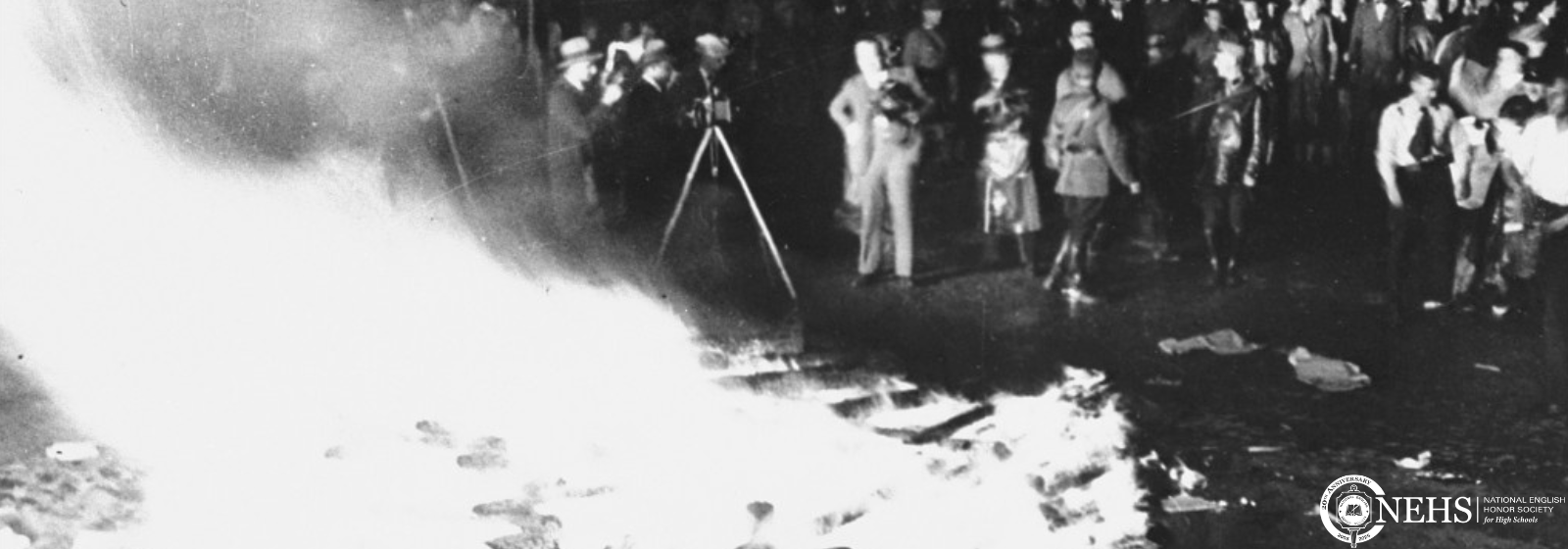
Furthermore, censorship can only lead to more censorship. While an extreme example, in Hitler’s Germany a month following the burning of the Reichstag, President Hindenburg signed the Emergency Decree for the Protection of the German People, which allowed the Nazi party to seize power over the Weimer Republic permitting the persecution and unwarranted arrest of “enemies of the Republic” and the elimination of all personal liberties. Still, this was not enough for the ruling party. In March of 1933, two months after the fire, Hitler’s Enabling Law was passed, making the legislative body of the Reichstag invalid, effectively bestowing him the title of Führer. This led to total repression of the freedoms the German people once had under the crippled, yet free Weimer Republic, as well as the banning and burning of books and other media that might be deemed Un-German. Sound familiar? Censorship, in whatever wicked form it takes, is still censorship. Such stifling of civil liberties is unjust in any way and must not be done to literary achievements such as Stamped.
Stamped explores a subject that is familiar yet unspoken by many: race. More specifically, its effect on the development of America. It is essential that this book persists in American libraries as it provides material, that can be used today that practically no textbook can give students. In an interview with NPR, the authors promised that Stamped “mixes past with present—in a way that young adults can relate to,” creating for a greater understanding of the ideals of antiracism (Nadworny). Antiracism, defined by Merriam-Webster, simply means, “opposed to racism.” This is exactly what Reynolds and Kendi are attempting to do: end racism. They do so through education of the past; criticisms of our past. Afterall, those who forget the past are doomed to repeat it. While those opposing the authors may suggest that such a pessimistic approach on United States history is un-American and harmful to children, in reality, such criticisms of our past can help effect our future. Our future as a nation with liberty and justice for all; but for real this time.
Reynolds’ and Kendi’s Stamped: Racism, Antiracism, and You and books like it must continue to be seen on school library shelves as this would continue the security of the 1st Amendment freedoms of readers and writers alike, combat censorship, and finally maintain the learning of Black history. Authors should not be punished for their achievements but instead celebrated for what they contribute to our society. In order to continue to do so, we must never allow the tragic suppression of media in this country, merely due to its content being “unsuitable” for the school environment.

Daniel Nieman is a senior currently attending Tabb High School in Yorktown, VA. He enjoys writing, history, and everything aviation related, as expected from an Air Force child. Thanks to the Air Force, he has lived in many exotic places such as Kansas and South Korea as well traveling to many different countries. When he is not in school, he is at one of the many clubs that he occasionally regrets joining or out playing with the marching band on an instrument that no one has ever heard of, that being the mellophone. Daniel plans to attend college following senior year and hopes to major in something he truly enjoys. If one thing is for sure, he intends to continue writing to some degree for as long as it brings him joy.
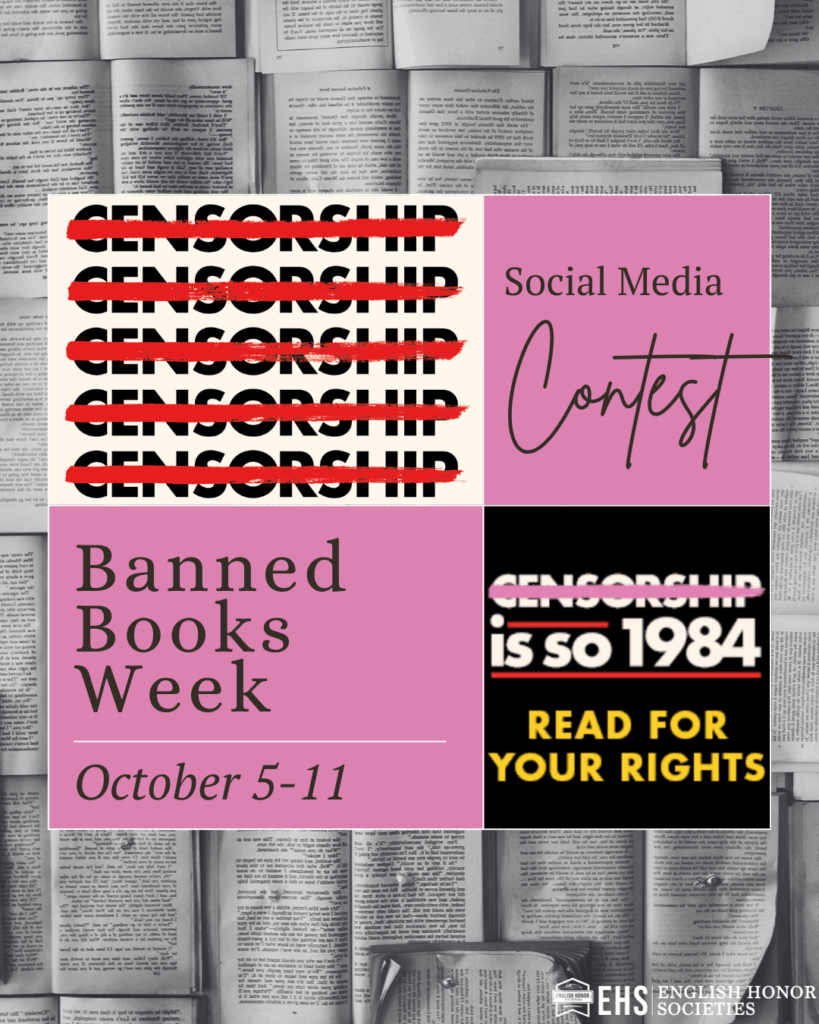
2025 Banned Books Week Social Media Competition
In celebration of Banned Books Week (October 5 – 11, 2025), NEHS, Sigma Tau Delta, and the ELA Honor Society are teaming up to host the tenth annual Banned Books Week social media contest for student members and Chapter Advisors. To participate you must tag us in a post on any of the following social media accounts:
- NEHS Facebook
- NEHS Twitter (@NEHSXPress)
- English Honor Societies Instagram (@EnglishMatters)
What to do in Your Post:
Books are banned for a variety of reasons. Take your own original photo of your favorite banned book and share with us (on one social media platform) one of the reasons it has been contested. If you wish to post on a second platform, please choose a second banned book to post about.
The contest will run October 5 – 11, 2025. Everyone who participates during this time frame will be entered in a drawing to win one of three $25 Bookshop.org gift cards. A $50 Bookshop.org gift card will also be awarded for the best overall post.
National English Honor Society
The National English Honor Society (NEHS), founded and sponsored by Sigma Tau Delta, is the only international organization exclusively for secondary students and faculty who, in the field of English, merit special note for past and current accomplishments. Individual secondary schools are invited to petition for a local chapter, through which individuals may be inducted into Society membership. Immediate benefits of affiliation include academic recognition, scholarship and award eligibility, and opportunities for networking with others who share enthusiasm for, and accomplishment in, the language arts.
America’s first honor society was founded in 1776, but high school students didn’t have access to such organizations for another 150 years. Since then, high school honor societies have been developed in leadership, drama, journalism, French, Spanish, mathematics, the sciences, and in various other fields, but not in English. In 2005, National English Honor Society launched and has been growing steadily since, becoming one of the largest academic societies for secondary schools.
As Joyce Carol Oates writes, “This is the time for which we have been waiting.” Or perhaps it was Shakespeare: “Now is the winter of our discontent made glorious summer . . .” we celebrate English studies through NEHS.
National English Honor Society accepts submissions to our blog, NEHS Museletter, from all membership categories (students, Advisors, and alumni). If you are interested in submitting a blog, please read the Suggested Guidelines on our website. Email any questions and all submissions to: submit@nehsmuseletter.us.
