

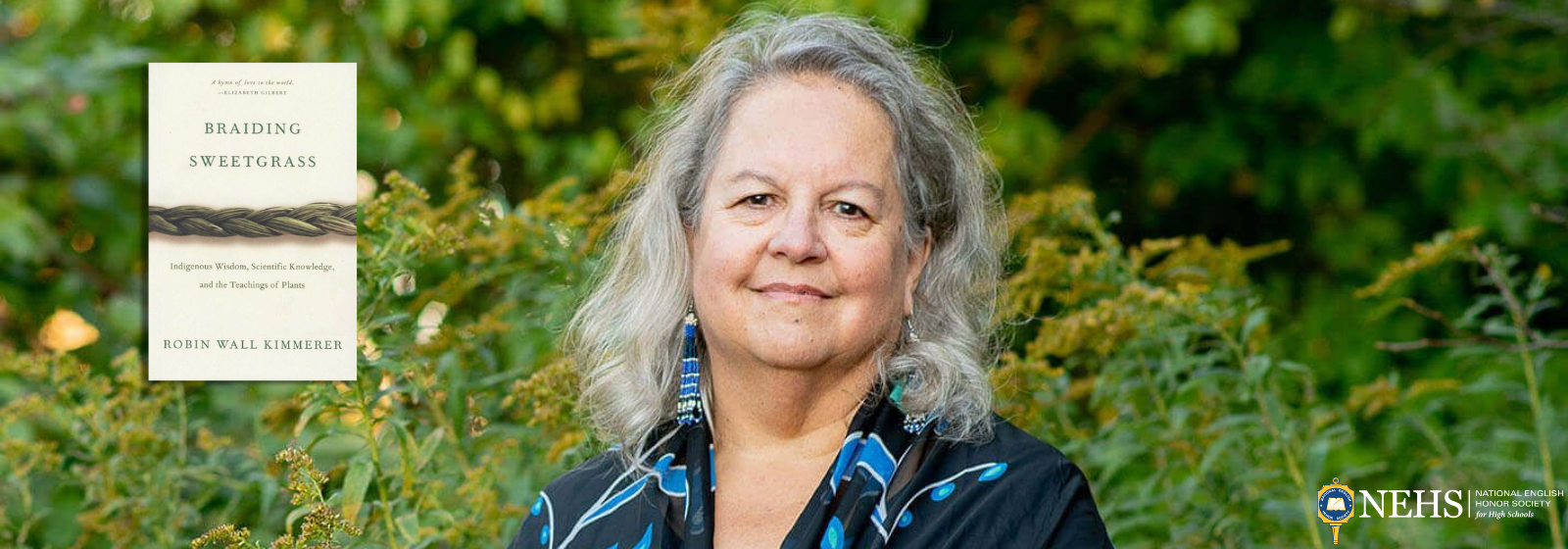
Books have the power to shape how we see ourselves and the world around us. In this thoughtful reflection, Grace Kireta of P.K. Yonge Developmental Research School, FL, shares how reading Braiding Sweetgrass by Robin Wall Kimmerer transformed her understanding of environmental stewardship, reciprocity, and the lessons that literature can teach.
Literary Lessons: Planting Seeds of Care with Braiding Sweetgrass
Inspired, I sit on my bedroom floor scanning my tower of books. The colors, fonts, cover designs, all imploring me to turn to the first page. I start at the top of the stack, taking in each book until I finally see Robin Wall Kimmerer’s Braiding Sweetgrass.
I have to play a game of tug-of-war to free the book. My hand glides across what seems like hundreds of sharp, awkward tabs jutting from its pages. They’re all either creased or folded in some way. Each colorful tab stuck out like a chaotic rainbow of revelation. The cover is worn after being repeatedly stuffed into my already full backpack; the bottom corner of the cover is rolled outward like a little hand reaching for me, inviting me to wade through its stream of lessons once again.
Through these pages, I was shown that my place in the world instills a duty of care, not just to people, but to the systems of Earth that make life possible. Respecting these systems is essential.
I look over my annotations and see how they have grown. Pencil turns to pen, and each underline wobbles across the page. Harsh arrows, sharp boxes, and squiggly circles contain the scores of revelations I experienced when I first traversed these pages; I now get to experience them all over again.
When we consider humanity’s impact on the natural world, images of climate change, deforestation, and pollution are often the first to come to mind. It’s easy to see how we’ve separated ourselves from nature to the point that we think of ourselves as the enemy. However, this only perpetuates the problem. In reality, contrary to what Western science often suggests, our interactions can be regenerative, not just destructive. One story from Braiding Sweetgrass really stuck with me: Laurie, a student researching the disappearance of sweetgrass, found that unharvested, untouched sweetgrass suffered, “choked” by dead stems, while plots that were harvested annually flourished. Laurie’s research and Kimmerer’s work reminds me that when guided by respect and reciprocity, humans are indeed a vital component of the natural world.
As I read, it wasn’t just the lessons about humans showing reciprocal care for the Earth that remained with me, but also how Kimmerer challenged the concept of knowledge itself.
She shows that objective thinking overlooks Indigenous traditions, which view humans as participants rather than outsiders. While data and logic will always have an essential place in research, she reminds us that there’s also truth in feeling. A garden may thrive because of phosphates and nitrates, but it also flourishes through care, a relationship built over time. When we tend to the Earth and supply its necessities for life, it responds. The vegetables and flowers begin to feel less like outcomes and more like gestures of gratitude, a “thank you.”
I attend native plant garden weedings and organize litter cleanups because I care about the well-being of the planet, but my interest goes deeper. The feeling I get is like that of showing up for a friend, mutual and rooted in care. These small acts are the ways I honor my relationship with the Earth. While it provides for me, I do what I can to take care of it in return. Just like any good friendship, giving goes both ways.
As I close the cover, I take one more look at the roughened edges, stained and creased like a childhood toy labeled well-loved after years of use. Books offer lessons that most teachers and classes can hardly match. Readers are considered lucky if they find the book that alters their lives forever. I count myself as one of the lucky ones. With one final, quiet, deep breath, I place this great work back onto my shelf until we meet again. As I move forward, I carry its lessons with me, into classrooms, communities, and every space where care can take root.

Braiding Sweetgrass by Robin Wall Kimmerer helped Grace Kireta realize her passion for environmental stewardship. Like many individuals, she finds that books often spark meaningful change. Grace is graduating from P.K. Yonge Developmental Research School. Throughout her high school career, she has devoted much of her time to sponsoring environmental projects and connecting community environmental organizations with her school. On Earth Day 2025, she organized a litter cleanup and education day with Keep Alachua County Beautiful for 2nd and 3rd-graders. In April 2026, coordinating with a local state park, Paynes Prairie, and the University of Florida’s Natural Area Teaching Laboratory, she organized two weekends of rounding up invasive Coral Ardisia from areas in Gainesville. As a member of her school’s Environmental Conservation Organization for four years, she’s always been heavily involved in maintaining her local environment.
National English Honor Society
The National English Honor Society (NEHS), founded and sponsored by Sigma Tau Delta, is the only international organization exclusively for secondary students and faculty who, in the field of English, merit special note for past and current accomplishments. Individual secondary schools are invited to petition for a local chapter, through which individuals may be inducted into Society membership. Immediate benefits of affiliation include academic recognition, scholarship and award eligibility, and opportunities for networking with others who share enthusiasm for, and accomplishment in, the language arts.
America’s first honor society was founded in 1776, but high school students didn’t have access to such organizations for another 150 years. Since then, high school honor societies have been developed in leadership, drama, journalism, French, Spanish, mathematics, the sciences, and in various other fields, but not in English. In 2005, National English Honor Society launched and has been growing steadily since, becoming one of the largest academic societies for secondary schools.
As Joyce Carol Oates writes, “This is the time for which we have been waiting.” Or perhaps it was Shakespeare: “Now is the winter of our discontent made glorious summer . . .” we celebrate English studies through NEHS.
National English Honor Society accepts submissions to our blog, NEHS Museletter, from all membership categories (students, Advisors, and alumni). If you are interested in submitting a blog, please read the Suggested Guidelines on our website. Email any questions and all submissions to: submit@nehsmuseletter.us.
