
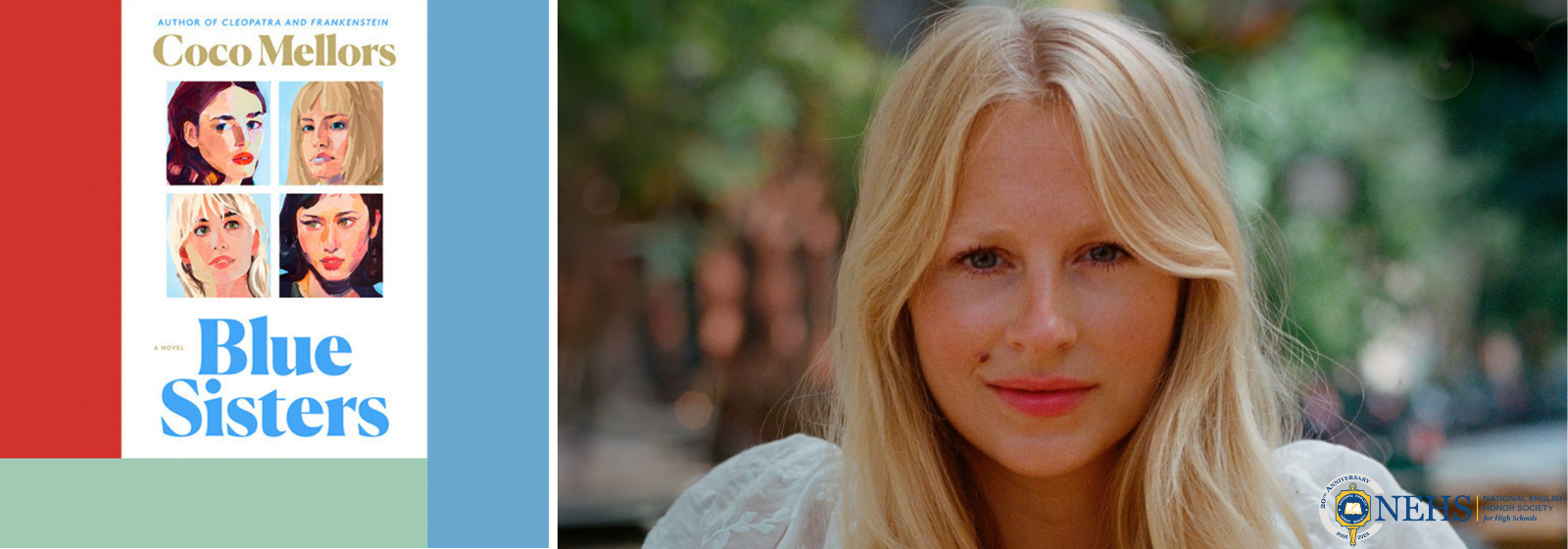
In Blue Sisters, Coco Mellors crafts a poignant portrait of siblinghood, loss, and the long road to healing. In this blog post, NEHS member Jenna Lee, from the Singapore American School, dives into the emotional core of the novel, reflecting on how Mellors captures the realities of grief and the enduring complexity of sisterhood. In her submission, Jenna explores themes of identity, trauma, and addiction—both to substances and to pain itself. Read on to find out more about Jenna’s invitation to consider not just what it means to love, but what it means to keep loving after significant changes.
Revisiting Grief and Rebuilding Sisterhood: Blue Sisters
“A sister is not a friend. . . . No. True sisterhood, the kind where you grew fingernails in the same womb, were pushed screaming through each other, is not the same as friendship. . . . You’re part of each other, right from the start” (Mellors 3).
In her second novel, Coco Mellors weaves intricate themes of identity and sisterhood with layered characters to produce a thoughtful narrative: Blue Sisters. The novel, whose cover is filled with blue hues, is much less an exploration of being blue than the exploration of being a Blue. Once a team of four, the sudden death of a Blue sister, Nicky, leaves the others grappling with life as a trio, the harmonic symmetry of being a square replaced with a pointed, unfitting triangle.
The eldest Blue, Avery, leads a meticulously developed life—crafted down to the timestamps of her daily routines and diction of her words—in London with her wife, Chiti. Tasked in her adolescence with caretaking for her sisters in place of her emotionally absent mother and alcoholic father, Avery works to separate her own identity by bearing over her sisters’ experiences, personalities, and likes. This habit reached a peak after Nicky’s death: Avery’s guilt about not helping her sister traps her in a cycle of continuous, impulsive, and bad decisions. Contrastingly, Bonnie, the second sister, conducts a more stoic life by disregarding her former job as a national champion boxer. Without Nicky, Bonnie’s fellow middle sibling, Bonnie struggles to calm her remaining fiery siblings and maintain the peace within their group dynamic. Finally, Lucky, the youngest sister, is forced to confront her tumultuous and party-fueled life. To the reader, it seems that Lucky is gambling away her life through a series of dangerous incidents, part of being trapped in grief, but for Lucky, it is the freest she’s ever been.
A year after Nicky’s death, upon learning that their house will soon be up for lease, the Blue siblings finally reunite back at their family apartment to look through Nicky’s belongings. Yet, as the sisters are faced with the reality of each other’s presence, they must choose between baring their secrets to one another or guarding their vulnerabilities for fear of judgement.
The story, though rooted in the relationships between the sisters, is so much more than just this. Another central theme of the novel is addiction, something Mellors has been open about experiencing herself in her teenage and adult years. Avery, a recovering heroin addict, and Lucky, a regular user of drugs and alcohol, walk a tightrope when discussing addiction. Despite Avery’s well-intentioned attempts, the words she hurls at Lucky in periods of anger give her an insatiable urge to disobey her sister’s advice. On the other hand, while Bonnie has never touched alcohol or drugs in her life, she self-proclaims that she is “addicted to pain.” Readers are left to discover what exactly this “pain” is and whether she will succumb to it or overcome it.
I hope that readers will be enraptured by this emotionally pigmented novel. NEHS members should be captivated by this modern masterpiece and its discussion of sibling-shaped love.

Jenna Lee is a fifteen-year-old sophomore who—clearly—loves books, research, and writing. Having immigrated from Korea at an early age, she has explored multilingual literature and recommends works like Wuthering Heights and The Bell Jar. Her current research interests concentrate on Southeast Asian conflicts like the Vietnam War and Khmer Rouge. Beyond her love for the humanities, Jenna is an active participant in the fields of dance, education, and service. Recently, though in vain, she has been passionately pursuing the path of using her Model United Nations skills to convince her mother to let her foster a cat. In August, she will begin her junior year at Singapore American School.
National English Honor Society
The National English Honor Society (NEHS), founded and sponsored by Sigma Tau Delta, is the only international organization exclusively for secondary students and faculty who, in the field of English, merit special note for past and current accomplishments. Individual secondary schools are invited to petition for a local chapter, through which individuals may be inducted into Society membership. Immediate benefits of affiliation include academic recognition, scholarship and award eligibility, and opportunities for networking with others who share enthusiasm for, and accomplishment in, the language arts.
America’s first honor society was founded in 1776, but high school students didn’t have access to such organizations for another 150 years. Since then, high school honor societies have been developed in leadership, drama, journalism, French, Spanish, mathematics, the sciences, and in various other fields, but not in English. In 2005, National English Honor Society launched and has been growing steadily since, becoming one of the largest academic societies for secondary schools.
As Joyce Carol Oates writes, “This is the time for which we have been waiting.” Or perhaps it was Shakespeare: “Now is the winter of our discontent made glorious summer . . .” we celebrate English studies through NEHS.
National English Honor Society accepts submissions to our blog, NEHS Museletter, from all membership categories (students, Advisors, and alumni). If you are interested in submitting a blog, please read the Suggested Guidelines on our website. Email any questions and all submissions to: submit@nehsmuseletter.us.
