
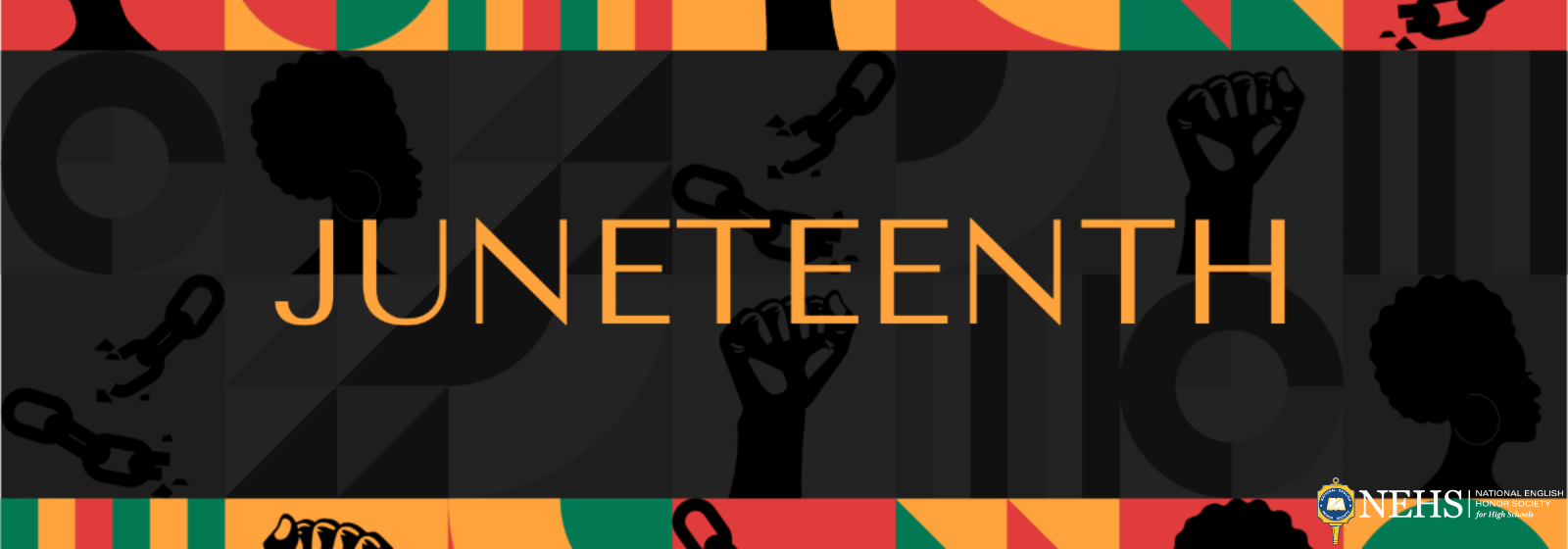
This week, Seneca Valley High School, MD, juniors and NEHS members Eyram Agboyibor and Anisa Ullah explore the history, traditions, and cultural significance of Juneteenth. Their blog highlights the importance of honoring Black history through community celebrations, education, and literature while reflecting on the enduring themes of freedom, identity, and resilience.
Find out more about Juneteenth activities and events you can participate in.
Juneteenth: Highlighting Traditions
Juneteenth, often called America’s second Independence Day, commemorates the emancipation of enslaved African Americans and celebrates the resilience, culture, and achievements of Black communities. Traditions have been passed down from generation to generation, making this holiday an important time to honor both the hardships and successes that have shaped Black American history.
Like many holidays, Juneteenth is celebrated with parades, music, historical reenactments, and community festivals. Another important part of Juneteenth celebrations happens at Historically Black Colleges and Universities (HBCUs). These events strengthen connections among students, faculty, alumni, and local communities while preserving and celebrating Black culture. Common traditions include public forums, panel discussions, educational lectures, alumni gatherings, networking events, and festivals featuring Black-owned businesses and student performances.
When we think about HBCU Juneteenth traditions, The Blackening, a film you should put on your list, comes to mind. The movie follows a group of friends who reunite to continue a Juneteenth tradition that began during their college years. Although the film is a horror-comedy, it explores themes of identity, stereotypes, and belonging while highlighting the importance of friendship and community. Its blend of humor and social commentary reflects some of the conversations that continue to shape Black experiences in America.
There are many ways for everyone to celebrate or support Juneteenth. Those who participate in the holiday may attend community events, spend time with family and friends, or host gatherings of their own. Others may choose to honor the day by learning more about local Black history, supporting Black-owned businesses, or engaging with educational resources that deepen their understanding of the holiday’s significance. Even small acts of recognition can help promote awareness and appreciation.
The meaning of freedom is often best understood through the stories people tell. Juneteenth is a time to remember the voices that shaped Black history and culture in America. Literature plays a significant role in preserving these stories, keeping themes of identity, hope, struggle, and liberation alive for future generations. Reading books connected to Black history can help readers better understand the lasting impact of slavery, segregation, and the ongoing pursuit of justice.
One remarkable novel to add to your reading list is Beloved by Toni Morrison. This award-winning work explores the psychological wounds left by slavery through vivid language and unforgettable characters. Morrison examines memory, grief, survival, and freedom while revealing how the past continues to influence the present. The novel’s emotional depth encourages readers to reflect on the human cost of oppression and the strength required to overcome it.
Another powerful book for young readers is Brown Girl Dreaming by Jacqueline Woodson. Written as a memoir in verse, the book follows Woodson’s childhood during the Civil Rights Era and explores themes of identity, family, belonging, and storytelling. Through thoughtful and accessible language, she shares experiences that illuminate both the challenges and resilience of growing up as a Black child in America.
Reading these books encourages meaningful conversations about freedom, identity, and historical understanding. Literature allows readers to become witnesses to history while connecting with experiences that continue to shape our nation today. Juneteenth calls on us to remember our past, celebrate our progress, and look toward a more inclusive future. As we gather beneath the same sky, we carry forward traditions that honor those who came before us and inspire generations yet to come.

Eyram Agboyibor is an 11th-grade student at Seneca Valley High School. She is a member of the National English Honor Society and participates in Science and Math National Honor Societies, and founded Smile Services, a service appreciation letter, SSL hour club. In school, Agboyibor is interested in chemistry and other sciences. She has been involved in her local NNACP Act-So competition branch and placed bronze in the instrumental contemporary category. Outside academics, Agboyibor spends time playing her electric guitar, catching up on recommended movies and series, and spending time with her family. Inspired by a special someone she admires, she hopes to major in chemistry at university and become a materials scientist.

Anisa Ullah is an 11th-grade student at Seneca Valley High School. She is a member of the National English Honor Society and participates in several school organizations, including the Muslim Student Association, National Science Honor Society, National Math Honor Society, and American Institute for Architecture Students, where she holds leadership roles. In school, Ullah focuses on architecture, math, and English. She has strong skills in communication, analysis, and time management. She has worked on AutoCAD design projects in her Construction Management and Design class and is working toward an AutoCAD certification. She has also earned 2nd place twice in Carnegie Mellon University CSP competitions. Outside of academics, she is active in volunteering, serving as President of Smile Services and a Sunday School Volunteer Lead, where she mentors and organizes other students. In the future, Ullah hopes to study architecture in college and pursue a career in the field, combining design skills with leadership and community service.
National English Honor Society
The National English Honor Society (NEHS), founded and sponsored by Sigma Tau Delta, is the only international organization exclusively for secondary students and faculty who, in the field of English, merit special note for past and current accomplishments. Individual secondary schools are invited to petition for a local chapter, through which individuals may be inducted into Society membership. Immediate benefits of affiliation include academic recognition, scholarship and award eligibility, and opportunities for networking with others who share enthusiasm for, and accomplishment in, the language arts.
America’s first honor society was founded in 1776, but high school students didn’t have access to such organizations for another 150 years. Since then, high school honor societies have been developed in leadership, drama, journalism, French, Spanish, mathematics, the sciences, and in various other fields, but not in English. In 2005, National English Honor Society launched and has been growing steadily since, becoming one of the largest academic societies for secondary schools.
As Joyce Carol Oates writes, “This is the time for which we have been waiting.” Or perhaps it was Shakespeare: “Now is the winter of our discontent made glorious summer . . .” we celebrate English studies through NEHS.
National English Honor Society accepts submissions to our blog, NEHS Museletter, from all membership categories (students, Advisors, and alumni). If you are interested in submitting a blog, please read the Suggested Guidelines on our website. Email any questions and all submissions to: submit@nehsmuseletter.us.
