
NEHS champions scholarship, leadership, and a deep engagement with language and ideas, and, thus, finds natural kinship with the world of Model United Nations (MUN). In this blog, Tom Wingate, Chapter Advisor of The Marshalsea Chapter in Mexico City, explores how three NEHS student members bring their passion for literature into the high-stakes world of international debate. Their experiences highlight powerful connections between the skills developed as NEHS members and the global perspective required in MUN settings. In doing so, they reveal how NEHS fosters not only literary excellence but also real-world readiness.
The Delights and Drama of Model United Nations Debating
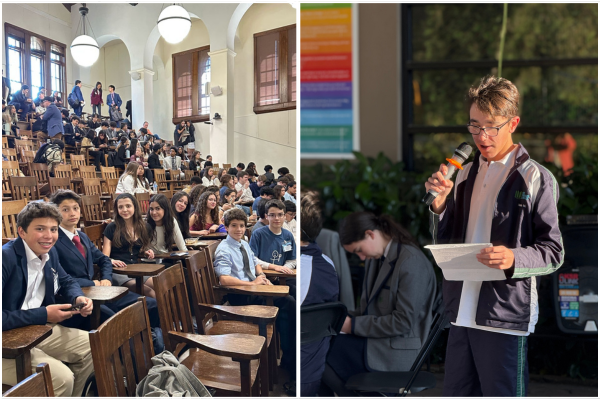
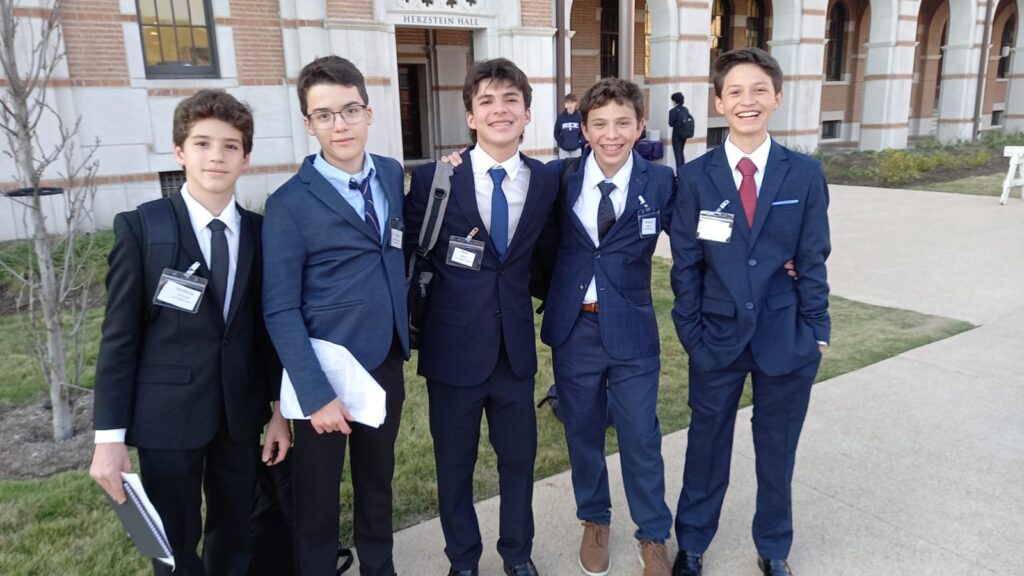
A teacher of English literature all my career, one extended lunchtime I had the opportunity to interview three NEHS members who are also fine Model United Nations debaters at our Mexico City British-international school. Namely, Isabella (15), Federico (16), and Alexa (17), the latter an IB DP student. I soon noticed that they all happily still talk of going to California last year to attend an MUN conference. Well, two questions uppermost in my mind were: what attracted you to become an MUN debater, and are there useful links between the skills involved in debating and your study of literature and NEHS?
Motivation
Although the youngest, with over three years now under her belt, Isabella has the most experience with MUNs. She cites a past History teacher who suggested that she try: her older brother had enjoyed taking part and that gave her a final push. And she has not looked back. Indeed, her two older colleagues generously attributed her enthusiasm for their own subsequent involvement, going so far as to call her a mentor. Fede also admits that the desire to be “proved right,” hopefully “suggesting real solutions to real problems,” appeals to him, plus a growing curiosity “to see how students educated in other lands would see those same problems.” As for Alexa, who had tasted ordinary debates before, she is clear that the “empathy that can be generated learning about different cultures” in both literature and MUN debating is a powerful stimulus for her.
Delights
Alexa also claims MUN debating allows participants to develop a “larger perspective on the world, widening the life students live in an international school environment.” While Isabella gives more weight to a necessary interest in History (indeed, currently researching the Fall of Rome for her next MUN competition in Texas), Alexa believes that the skills she has much enjoyed learning as a member of NEHS, such as decoding literature have much to say to her as a debater, too. Last year, when reading White Tiger by the Indian author, Aravind Adiga, she clearly remembers how it worked at the level of character and plot, of course, but also at that of a broad and, to her, “unknown” culture. Like the cultural empathy she enjoys in the MUN jousts, the novel’s mind-expanding opportunities provided to her are very worthwhile. Fede echoed the thought, this time with reference to Nigerian author Chimamanda Ngozi Adichie’s sometimes unsettling work, Purple Hibiscus.
While you do not finally “win or lose in MUN debates,” most of all our debaters concur about getting a real thrill when “shifting people’s perspectives through the application of well-phrased arguments,” themselves the result of careful research. Founded on a bedrock of mined facts and perspectives, a solid case can be presented. Wow! You then feel you are “on the top of a pedestal.” To cap that, you just might receive a special mention—a “Best Delegate” perhaps?—in the awards ceremony.
Drama
As an NEHS member, Studying English and English Literature also have been an important part of Fede’s Cambridge International General Certificate in Secondary Education (IGCSE) curriculum here in Mexico City. Just knowing how to speak in public, and in front of large audiences, have been “daunting targets to meet.” Dramatic moments, and Isabella agrees. “Dealing with stress,” by looking and sounding confident during presentations, is part of the whole activity. Curiously, when given the chance, she also deliberately increases her internal tension by debating the point of view that is not her own! For example, when in California, she was allocated a Middle East peace-keeping role for a country whose role was “too clear.” Representing a country that has to walk a tight-rope, and make subtle arguments, can be tough. But, “nice tough” and, to her, “more fun!”
MUN and the Real World
At college, Fede most probably will study medicine, Isabella Political Science, Alexa Psychology. They acknowledge that it will be unlikely to meet up in New York in a few years as actual UN diplomats. However, young though they are, the problem-solving experiences that the MUN and NEHS have already given them are greatly appreciated. “They,” quite simply, “prepare you for life.” Just as much literature is “not true,” being fiction, that same argument can be leveled at anyone who juggles with life’s problems at MUN conferences. And yet both activities are, as the British poet Philip Larkin once said of his own literary genre, certainly “life-enhancing.” Having done battle with facts and ideas, these MUN debaters and NEHS members become more complete, well-rounded people who are better able to see issues in themselves and others, and help restore the harmony we all seek, whether at the level of individual human beings or, yes, even entire countries.
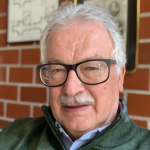
Tom M J Wingate
The Marshalsea Chapter, Advisor
The Wingate School – An Inspired School, Mexico City
National English Honor Society
The National English Honor Society (NEHS), founded and sponsored by Sigma Tau Delta, is the only international organization exclusively for secondary students and faculty who, in the field of English, merit special note for past and current accomplishments. Individual secondary schools are invited to petition for a local chapter, through which individuals may be inducted into Society membership. Immediate benefits of affiliation include academic recognition, scholarship and award eligibility, and opportunities for networking with others who share enthusiasm for, and accomplishment in, the language arts.
America’s first honor society was founded in 1776, but high school students didn’t have access to such organizations for another 150 years. Since then, high school honor societies have been developed in leadership, drama, journalism, French, Spanish, mathematics, the sciences, and in various other fields, but not in English. In 2005, National English Honor Society launched and has been growing steadily since, becoming one of the largest academic societies for secondary schools.
As Joyce Carol Oates writes, “This is the time for which we have been waiting.” Or perhaps it was Shakespeare: “Now is the winter of our discontent made glorious summer . . .” we celebrate English studies through NEHS.
National English Honor Society accepts submissions to our blog, NEHS Museletter, from all membership categories (students, Advisors, and alumni). If you are interested in submitting a blog, please read the Suggested Guidelines on our website. Email any questions and all submissions to: submit@nehsmuseletter.us.
