

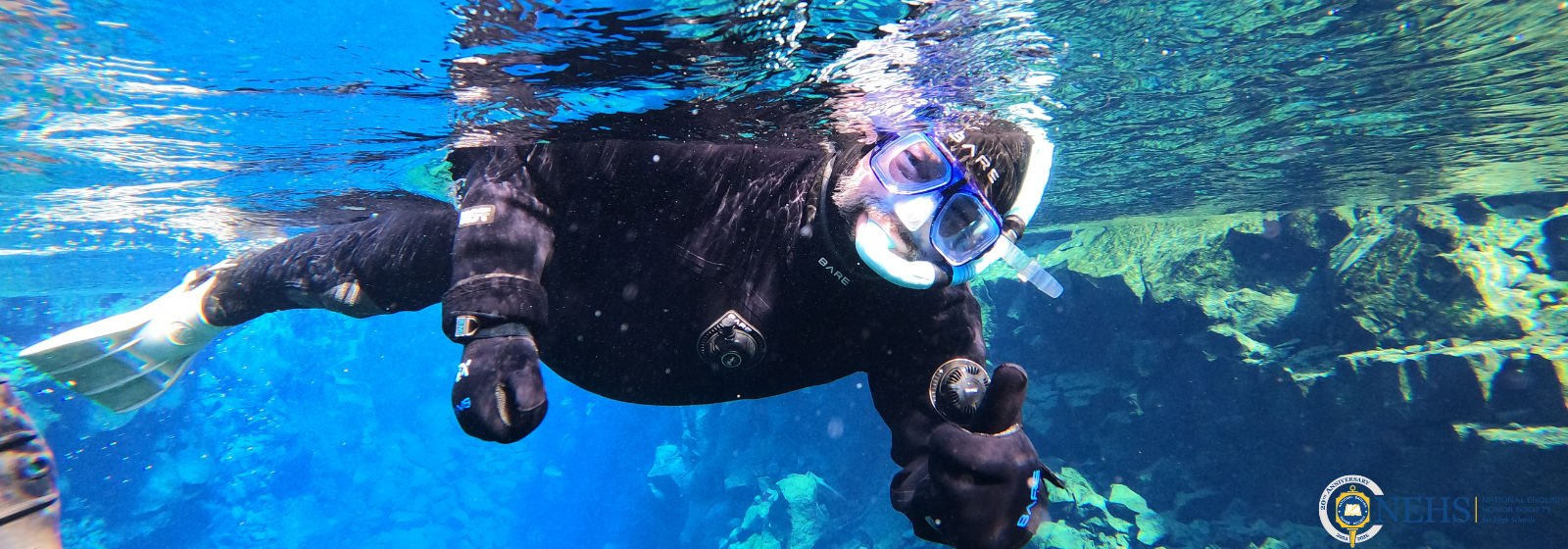
As part of NEHS’ celebration of the spirit and legacy of David “Dave” Hebestreit (1971–2025), we are proud to announce the inaugural winners of the Hebestreit Award for Adventure Writing.
A member of the NEHS Advisory Council, Dave was a tireless advocate for student voices and a true believer in the power of storytelling to illuminate life’s most meaningful journeys. His deep love for literature, education, and adventure touched countless lives within the NEHS community and beyond.
Established in his memory, the Hebestreit Award honors Dave’s boundless curiosity and passion for exploration—whether that exploration is through travel, learning, or personal growth. The award invites both NEHS student members and Chapter Advisors to reflect on adventures that have broadened their horizons, challenged their perspectives, or simply helped them see the world in a new light.
This year’s recipients exemplify the values Dave championed: courage, reflection, and a willingness to embrace the unknown. Through their vivid, heartfelt writing, they carry forward his legacy—proving that every adventure, when shared through words, has the power to connect and inspire.
Read on to be inspired by our inaugural winners.
Student Winners
Crisis in the Sea of Change
by Vannielys Ortiz Diaz, Antilles High School, Puerto Rico
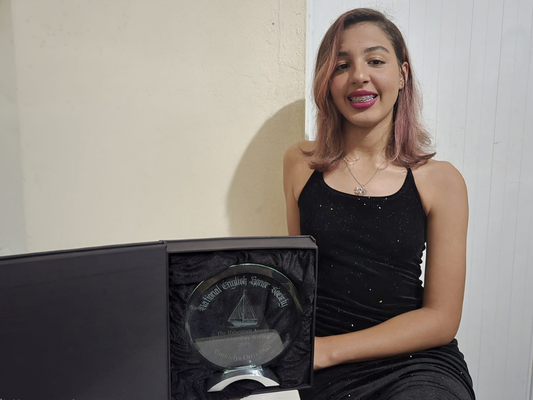
A story of how depression can make someone give up but, once there’s help, it can change their life forever.
The blue sea
Sitting calmly by her feet
A stagnant serenity
The girl sighed deeply
Enjoying the breeze
She looked down at the sea
It was her reflection
Yet it didn’t look pleased
But the girl was appeased with what she saw
At 9 years old
A world filled
With bright memories
She was content
Happy and carefree
Then, when the girl turned ten
The world shifted, never to mend
It didn’t feel the same
A strange sickness spread
Like a wave
Leaving hearts distant
Strong but frayed
In the sea
Her reflection shone bright
A figure that danced in the fading light
But as she gazed
Her heart skipped a beat
The reflection moved
With a chill in its greeting
With eyes unpleased, it drew near.
Curiosity mixed with fear.
Cautious steps brought her close
In a moment that felt coarse
Then with a hold like chains of fate
Her wrists were caught
It was too late
Into the depths
The waters embrace
A splash, a gasp in that cold place
Came to the surface
Heart racing Shivering still
Bewildered, pacing
The girl gazed down
Her heart in a swirl
In her reflection
She was a quiet girl
Her image spoke not
She just stared back into the stream
Then settled in stillness
Like a forgotten dream
A lesson learned
But not the last
For shadows linger
When moments pass
In the depths of her mind
A warning stirs
This tale of reflection forever blurs
Ever since that year
Things grew quite dire
On that fateful day
She faced her greatest mire
Each year, her reflection would throw her into the sea
Deeper and deeper
She would sink
Losing hope of being free
Breath grew heavy
Muscles began to weaken
On her fifteenth birthday
Her spirit felt beaten
She let herself drown
Surrendering to the deep
But then she felt a change
Stirring her from sleep
Could it be life or heaven’s call?
As she opened her eyes
She saw she’d not drowned after all
Surrounded by loved ones, their hands reaching wide
In that moment
She knew she wouldn’t need to hide
The reflection returned
With its dark, daunting gaze
But with her friends and family around
She was no longer amazed
They pushed back the being
Kept it far from shore
In that joyful moment
She felt like she could soar
Though she knew this battle wasn’t yet complete
With strength from her loved ones
She could stand on her feet
When the reflection approached
She stood firm and still
With courage in her heart
She faced it with will
Its face showed confusion.
It tried once again
But her newfound resolve
Was met in vain
The reflection withdrew
Retreating from sight
She knew it’d come back
But now she had might
This girl was strong
Struggle was real
A tale of depression
Yet her heart slowly healed
With help from family and friends
And ambition so bright
She learned how to manage
And walk into the light
Vannielys Ortiz Diaz is a kind yet shy sophomore student at Antilles High School in Puerto Rico who faced mental health challenges in her early teenage years. Despite the toll it took on her, she continued to find joy in swimming, reading, drawing, and helping others with similar struggles. After learning about the National English Honor Society, she joined and began writing poems to cope with her feelings. Although she recognizes that her writing is a work in progress, she is committed to improving her skills. Through her poetry, Vannielys hopes to inspire and support those who have experienced similar challenges, displaying that creativity can be a powerful tool for healing. With her dedication and kindness, she aims to positively impact others’ lives, reminding them that they are not alone in their struggles.
From Silence To Flame
by Leah Soormaghen, Milken Community School, CA
“Fires don’t ask permission to burn.” That line stuck with me from a podcast I listened to recently. As a junior in high school, if someone had told me that when I was 15, I wouldn’t have understood what that really meant. Sure, I could have probably explained the surface-level meaning of this analogy. However, it wasn’t until two years later, during my eleventh-grade spring break, as I listened to Leo Skepi’s The Aware & Aggravated Podcast, that I felt these words echo within my chest.
Entering my sophomore year of high school, I began to see the social world around me more clearly, and not in a good way. I noticed how people would talk about each other behind closed doors, how gossip and judgment were currency in the halls. It started to get to me, and I wondered if people were picking me apart the same way they did to others. If others had flaws worth judging, then obviously I did too. I started questioning my worth, and the more I did, the more detached I felt from the friends I once had. I cut ties with my old circle, hoping to reinvent myself. It was a messy and confusing time, but it marked the beginning of redefining who I was and who I wanted to be.
I experienced this painfully awkward stage where I felt completely isolated. I had no friends, no sense of self. I didn’t understand who I was, and it felt like nobody else did either. While chasing the idea of who I thought I wanted to be, I lost sight of who I really was, and in that disconnect, I became miserable. My personality was contingent on those around me, whatever was trending, whatever would make me blend in. I clung to anything that might have made me feel like I belonged, anything to silence the feeling that I was a loser. As a result, I created this mental cage for myself, constantly limiting myself to what I believed was acceptable to others. There is no feeling quite as sharp or distinct as truly hating yourself; it’s a quiet, constant ache that colors everything.
So, I started afresh. Naturally, I faced challenges. People whispered behind my back, twisting my choices into something ugly. Suddenly I was the villain in stories I hadn’t even written. Rumors spread, and friends vanished overnight. There were days I sat alone, and I cried more times than I could count. Over time, slowly, organically, I created my own little group. Just the five of us. But it felt whole. It felt right. For the first time in a long time, I felt genuinely loved. I didn’t have to change who I was to be accepted. I was fulfilled, and in that space of real connection, something shifted in me. I no longer felt the need to chase validation from people who barely saw me.
What makes their approval so important, anyway?
Why should their opinions dictate my life?
“Fires don’t need permission to burn,” and I don’t need others’ permission to speak, to be heard, to exist.
In a culture obsessed with image, and constant comparison, choosing to love oneself is a covert rebellion. It is the choice to live beyond the mental script illustrated by your insecurities. It is the choice to embrace the depths of who you are, to permit the existence of your imperfections despite the image of the perfect person you have yearned so long to be. It is not loud or easily defined, and it rarely looks like what the world tells us it should. Yes, my story is not particularly unique. In a world filled with seven billion people, I’m absolutely positive that everybody has fallen victim to wanting to “fit in” at some point in their life (especially during high school). Despite this nearly universal experience, the journey to self-love can only be forged through walking the hard road; shedding what does not belong to you until what remains is real.
Self-love is the quiet revolution of accepting yourself fully, flaws and all. Nothing is more degrading than measuring your worth based on how you think others perceive you, because in the end, it’s not their judgment that holds you back, it’s your own. Assuming everyone hates you leads to unshakable emptiness and loneliness, transforming you into a bitter, angry version of yourself. But the truth is, it’s your own self-hatred consuming you, not necessarily the judgement of others. The concept of self-love often feels like a paradox: you search relentlessly for it outside yourself, only to realize it has been within you all along. The harder you chase it through validation, the more elusive it becomes, yet the moment you stop seeking approval, it naturally emerges. It’s a riddle, asking you to find something that has been with you all along but feels impossible to see – where the answer is hidden in plain sight. Ultimately, true self-love begins when you stop searching for reasons to deserve it. I am enough without needing to be perfect, and for that reason alone, I am worthy.
Leah Soormaghen is a 17-year-old Junior at Milken Community School where she serves as the President of her chapter of the National English Honor Society, along with leading several other student organizations and being a cheerleader after school. A passionate and driven individual, she thrives in creative and academic spaces alike, spending her free time writing, exercising, and painting. As a second-generation Persian-Jewish girl, she draws strength from her cultural heritage and is deeply committed to honoring her family’s values and story. Inspired by her parents’ resilience and dedication, she strives to continue their legacy by pursuing a diverse and enriching education. With long-term goals of eventually stepping into her father’s business, she approaches every opportunity with intention and purpose. Whether through artistic expression or academic exploration, she seeks to make a meaningful impact while staying grounded in who she is and where she comes from.
What Lebanon Has Taught Me
by Joy Imbasala, Westminster Christian School, FL
Lebanon is breathtaking.
The kind of place that stays in your heart and with you.
Mountains with sheep and peaceful shepherds wherever you go.
Beaches where the sun gleams bright on the waves.
I ate food that felt like home and my grandmother’s meals.
I took a boat under a mysterious cave with blues at every sight,
And saw things I didn’t even think existed in this wonderful world.
It felt as if I was finding a treasure with hidden pieces of the world in it.
I’ve been lucky enough to visit there twice now.
Each summer trip left me with more than just memories,
Not just great times and laughter,
It left me with a grateful heart.
I’ve thanked Jesus for the chance to experience it,
To learn from it.
Every time I come back home,
I realize how much we complicate things.
Here, we stress over our AC not being cold enough,
Or our car being too small to fit just one more person.
We complain when things aren’t just good enough,
Like it’s the end of the world.
Despite all its beauty,
There are hidden parts of Lebanon that people don’t talk about.
Poverty, the struggle.
People there are living with so little,
And we don’t even realize it.
But even in that struggle,
They smile more than we do.
They’re content,
Because they’ve learned how to see the good in what they have.
They go to work with a smile,
Walk to school with purpose,
Thank God for every small thing they have.
They don’t wait for perfect days to enjoy life.
They find joy in small moments.
Even when their homes are finally apart.
Literally cracked walls, broken tiles, power going out.
And they fix it, somehow.
They make it work,
And still find reasons to be thankful.
And maybe that’s the lesson.
Maybe life doesn’t have to be this hard.
Maybe we should stop and realize that they can,
Certainly, do things in a more effective way,
Without the struggle.
Maybe we make it harder by focusing on what’s missing,
Instead of appreciating what we already have.
Lebanon has shown and taught me this.
Grateful hearts are built from having everything you want the easy way,
But it comes from satisfaction with what you do have.
Now, whenever I see myself complaining,
I remind myself,
There are people with so much less
Who live with so much more peace.
And they solve issues much more effectively,
And with a grateful heart.
And I think to myself . . .

Joy Imbasala is a student at Westminster Christian School. She focuses on taking all the science classes at her school, as she would like to major in Biology on a Pre-Med Track. From a young age, she was drawn to expressing her feelings through writing, especially through poems. Joy is currently involved in five different honor societies, has competed for a medical club called “HOSA,” is secretary for her church youth organization, is in many different clubs, taking a Biomedical Track at school (signature program), and has volunteered for different community service projects. She enjoys spending time with her family, traveling, science, and organizing events. She hopes that through her writing, she can inspire others and have a positive impact on everyone.
Chapter Advisor Winners
Seizing the Moment
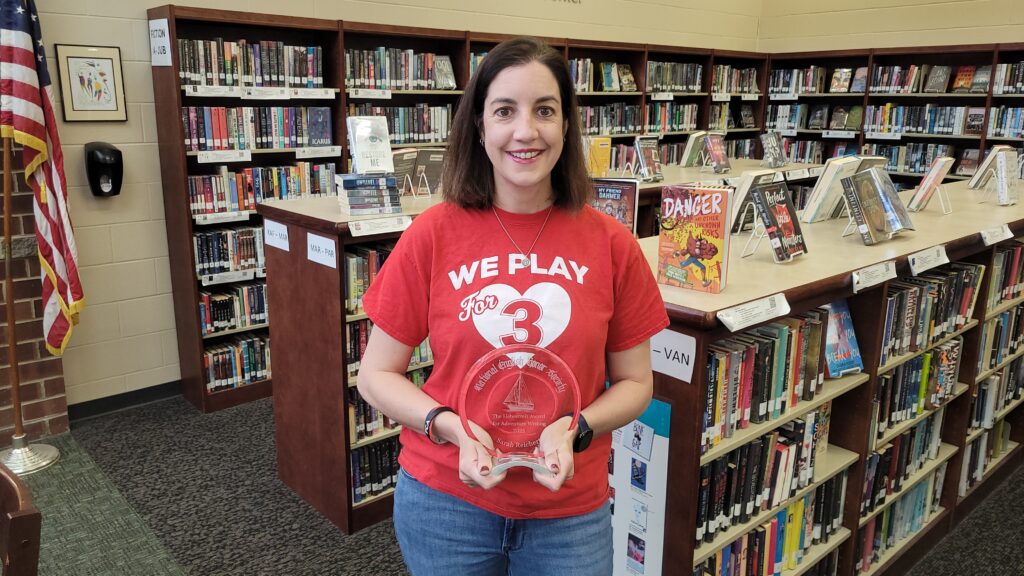
by Sarah Reichert, Westlake High School, OH
I’ve found myself pulled over to the side of the road many times as a driver. There’s that time I ran out of gas because I thought I could go just five more miles on fumes. That time I hit a deer as I drove home from a late-night event. Oh, and of course, there were police stops for speeding and an expired license plate.
This time, however, it was different. This time, my stop on the roadside was caused by something completely out of my control—my three-year-old daughter was having her fourth seizure in as many days, and I was at a complete loss as to what I could do for her.
A few days earlier, on July 25, 2015, my family and I participated in a local 5k race. While awaiting results, my husband and I played with our three-year-old twins. In the process, my daughter, Katie, hit her head on the pavement. We immediately attended to her, but she seemed fine, so we chalked it up to normal preschooler clumsiness and went home.
At home, my family sat at the kitchen table to have cereal while I scrolled through social media in the kitchen. I was interrupted by the clatter of her spoon hitting the floor and looked up to see her in her booster seat, arms stiff at her sides, back arched, eyes vacant.
After a lights-and-siren ambulance ride, a life flight, a CT scan, and an EEG, plus an overnight stay in the PICU, the staff at the children’s hospital determined the fall had not caused the seizures. We were sent home with a prescription for an anti-seizure medication and told to get help if she seized again.
She would have two more seizures in the days that followed.
That brings us to Tuesday evening. Katie went with me to grab a few groceries, and on the way home strange noises from the back seat alerted me to her fourth seizure. I pulled off on the next exit ramp, took her out of her car seat, and laid her in the grass. I called my husband, and we prayed.
While we were praying, I looked up from where I was sitting with Katie and saw a red pickup truck driving toward us. The driver parked, and he and his wife got out to offer help. As it turned out, she was a nurse at a school for special needs children, and he was an off-duty fireman. He called the squad while she checked Katie’s vitals and soothed her. I could not have asked for better support at that moment, a moment I couldn’t have envisioned in my wildest dreams.
My type A personality makes me a compulsive planner. I plan meals for each week, keep three calendars for my family’s activities, and schedule rides for the kids to school and sports.
There is a place for all of this planning. It helps my family run smoothly, makes sure everyone gets where they need to be, and ensures we are not grabbing fast food every night.
But, maybe that was the point of all of this. I couldn’t control everything—no matter how much I planned, how much I scheduled, there was nothing I could do to stabilize her brain. I had to give this one up—let the doctors, nurses, and other trained medical technicians work with Katie, and let God help us accept the situation and guide us to the right experts.
However, the discomfort I experienced at the onset of Katie’s generalized epilepsy was a turning point. I realized that in my attention to logistical details, I often lost sight of the human side of my family. My kids needed a mom who could relax and enjoy them, not plan their every move. When Katie was in the hospital being monitored, she didn’t need me to hover and fret; she needed me to play Candyland and watch Frozen for the millionth time.
This was my challenge: working through the difficulties of being a mother and an advocate for my child with epilepsy, while also trying to let go of my rigid need to control every situation.
While Katie, thankfully, outgrew her epilepsy by age 7, I haven’t outgrown my worries. Despite the neurologist’s reassurances, I am always waiting for the other shoe to drop on her recovery.
At age 13, she’s a dedicated volleyball player and a bright kid who’s a whiz at math and loves to read. She has overcome the problems that could have set her back for life and hasn’t looked back.
The gift of this experience is that I have learned to be present. While other parents are recording their kids’ every move, I am usually sitting back and enjoying the show—no matter how hard I try to set my kids up for success, they will blaze their own trails, succeed on their own, and I want to be in those moments with them, not planning what comes next.
Sarah Reichert is an AP English Language and Composition and English 11 teacher at Westlake High School in Westlake, OH. Along with another staff member, she founded the Westlake High School PanDEMONium Chapter of NEHS in 2019 and has enjoyed watching its impact on literacy growth in the local community. She holds a BA in English from John Carroll University and a Master of Arts in Counseling from Heidelberg University. When she is not teaching, Mrs. Reichert enjoys spending time with her thirteen-year-old twins, Katie and Alex, and her husband Matt. She enjoys reading, particularly nonfiction and historical fiction, cooking, watching her kids’ sports, and exploring new restaurants around Cleveland while rooting for the Browns, Cavs, and Guardians.
The Climb
by Dana Meehan, International School of Kigali, Rwanda
I’ve only felt truly close to death twice in my life. Both times we were reaching for summits in the Andes mountains. Growing up in Quito, Ecuador, I spent much of my childhood tagging along on smaller climbs. My dad had been climbing since his teenage years, back when he and his invincible teenage friends used bread bags as gators and climbed glaciers in jeans. Once I reached my teenage years, I preferred parties and shopping with friends, but my brother never gave up climbing. He and my dad would spend weekends scaling glaciers. My mom and I would stay home, hoping not to receive a phone call that there had been an accident.
Ecuador’s biggest draws are its highest peaks: Cotopaxi (19,348 ft.), and Chimborazo (20,548 ft.). My dad and brother had climbed both several times, and even guided others up them. My mom had made summiting Cotopaxi her goal for her 40th birthday. Despite my indifference in my teenage years, conquering Cotopaxi hovered in my mind as a rite of passage.
Once I graduated from high school and moved to the US for college, I realized what I had taken for granted. The adventures that my friends talked about didn’t compare to those I had grown up experiencing, and I realized how fortunate I had been. I returned to Ecuador for the summer of 2008, and while there, asked my dad to take me up Cotopaxi—it was finally my turn.
It would be my dad, me, and a family friend, Garret. We left my mom with the promise that we’d be back the next evening, and that the climb itself should take about eight hours. We slept a few hours in an abandoned refuge at the base of the volcano, and a few short hours later I was shaken awake in the pitch black to start the ascent. I could see strings of tiny lights up ahead—the other groups attempting to summit.
The three of us were roped together, and it was calming to hear the steady crunch of crampons on ice as we moved further up. At some point we reached a group that had decided to turn back due to the inclement weather. They warned us to do the same. My dad looked at me and asked what I wanted to do. I knew this might be my only opportunity, so I asked that we continue on.
I breathed a sigh of relief as we reached the Yanasancha, a band of black rock below the summit, immediately followed by a gasp of alarm as I felt a sharp tug at the rope behind me. I turned to see Garret, our family friend, lying face down in the ice. We asked if he was okay, and he gave a muffled affirmative response. We stopped to rest, and again my dad asked if we wanted to continue. The wind was picking up, and he warned that the next stretch to the top would be the most challenging. We were so close, and I wasn’t about to give up now. We continued on, maneuvering across a snow bridge and a steep ramp, which eventually led to an easy slope. By this time, though, the wind was so strong that we had to continue on our hands and knees. I didn’t contemplate that I may have made the wrong decision to continue; all I could think was that I was almost there. We reached the top in a complete whiteout and snapped some pictures, showing only our bright colored jackets. We didn’t stay to relish our victory, but instead quickly began our descent.
Thus began our true adventure—being lost in a whiteout and ending up on the wrong side of the mountain, doubling back time and time again to avoid crevices which appeared out of nowhere, debating whether to dig a snow cave to wait out the storm (an unfathomable idea to me), propelled forward by adrenaline alone. These hours are a blur to me. When we eventually made it off the glacier, hours after our expected return and well into the night, the adrenaline that had been pushing me forward gave out, and exhaustion took its place. As luck would have it, a search party from the official refuge (not the abandoned one we had spent the night in) had been sent out when we hadn’t returned and found us as they were driving around the base of the volcano.
When we called home and realized the agony we had put my mom and brother through, it struck me that this was my first time being on the other side of that situation. My mom had called my brother, who was off at college in the US, causing him the same agonizing feeling of helplessness. Hearing his voice break over the phone, I realized that I prefer being in the predicament, rather than helplessly waiting for news. The trauma of the experience eventually wore off, and a realization sunk in that not only had we survived, but that I wanted more.

Dana Meehan is a dedicated English teacher at the International School of Kigali in Rwanda. With 13 years in the profession, she is passionate about fostering a love for language and literature in her students. When not teaching, she prefers to be outdoors in nature and is an enthusiastic adventurer, frequently engaging in activities such as hiking through scenic landscapes and tackling challenging climbs.
Flocks of Pelicans
by Patricia Smith, Appomattox Regional Governor’s School, VA
Once upon a time, I lived in West Africa. I say once upon a time because my life that year often felt like a fairy tale, like I’d fallen down the rabbit hole into another existence. Who I was at home—a white, Irish Catholic lesbian—and who I was in Senegal felt like separate identities. In Senegal, unlike in the US, nearly all my friends were men. My only Senegalese female friends were the wives of colleagues. In Senegal, men were always interested in me, even my married colleagues, the ones I thought were my friends. At one point or another, they all made passes. Even the principal of the school where I taught let me know that he was interested. Miss, the men said from behind the window in the post office or at Senelec where I went to get my electricity turned on. You are bee-you-tee-ful American woman. I pay you coffee?
Being a western woman in Senegal was sometimes hard. It was difficult to understand, for example, why women couldn’t go to the movies by themselves. For a Senegalese woman, leaving her compound for a simple evening at the movies would be tantamount to leaping right into a script, or say, into a window of a New York City skyscraper, taller than the banyon tree in front of her house, the world outside busier than the dusty main street where she goes when she needs to buy cloth for Korité. Like her Catholic neighbors at Easter time, she needs to buy cloth for new outfits for herself, her husband and children to celebrate the end of Ramadan. She needs to bring the brightly colored cloth to her tailor far in advance because he will be busy making clothes for all the other women and their children and husbands.
From time to time, I went to the movies alone. I sometimes imagined my life in Senegal as a movie. I could even hear the soundtrack in my head—the rhythms as women shuffled into town with baskets sitting squarely on their heads, or pounded manioc, or cleaned dishes after meals.
Senegal, as I knew it, was divided into two nearly separate countries: the Sahelian North, colorless land broken up by cone-shaped huts and baobab trees that stretched from the Gambia River up to the border of Mauritania in the North and Mali in the East; and the tropical South, the Casamance, lush and green, pushing from the border of Gambia all the way to Guinea-Bissau. I lived in the Casamance, in Ziguinchor, the region’s capital. Back then, one main paved road cut through town, shuttered white colonial buildings on either side, palm trees, spreading banyons and kapok trees, bright pink bougainvillea, flocks of pelicans, vibrantly painted pirogues on the river, pigs and goats on the streets. Siestas became part of my daily routine and split the morning and afternoon teaching. I was on a Fulbright, teaching English to Senegalese high school students ranging in age from thirteen to twenty-two. The younger ones memorized dialogues about buying mangoes at the market and traveling around Nigeria and Ghana, though far more likely would be a trip to the Gambia, just an hour or two away. For my older students, I played songs from Louis Armstrong, Tracy Chapman, and Madonna. We read short stories and poetry. We talked and wrote about the differences between Senegalese and American values, discussing things like polygamy and women’s rights. When a border war broke out with Mauritania, we talked about the anti-Mauritanian violence that marred the holy month of Ramadan. My students talked passionately of revenge for Senegalese brothers killed in Mauritania. I told of how, one morning, my Mauritanian bread-seller stopped showing up at his little boulangerie. I told them, too, of the eerie two days I spent in Dakar during the most heated part of the conflict, of how I got off the commuter plane at Yoff Airport and looked out to infinite rows of crouched figures, their white robes blowing like curtains in a breeze, of how the roar of airplanes overhead didn’t stop for two days, of how the silence, after all the Mauritanians had been repatriated, finally hung, full of uncertainty.
As improbable as it sounds, I often felt at home in Senegal, though now, looking back through a great distance, maybe it was more like wishful thinking. I wanted to belong someplace. Maybe my own foreignness in the US, my own sense of not belonging, had opened in me a willingness to find myself elsewhere, to discover home in the most unlikely places. I got involved with a Senegalese man. I dreamed of what it might be like to prolong my stay, even trying to extend my one academic year to two.
Instead, my fairy tale came to an end. But as all good stories do, it stayed with me through time, all the color and sounds, the images and voices, all the questions and wonder, all the passages and possible answers to who I might become.
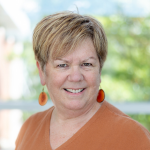
Patricia Smith teaches dual enrollment English and literary arts at the Appomattox Regional Governor’s School in Petersburg, VA, where she is also English Department Chair and the Advisor to their NEHS chapter, the Scriveners. She is the author of the novel The Year of Needy Girls, a 2018 Lambda Literary Award finalist. Thrice nominated for a Pushcart, her nonfiction has appeared in several anthologies and literary magazines. She lives in Chester, VA, with her wife.
National English Honor Society
The National English Honor Society (NEHS), founded and sponsored by Sigma Tau Delta, is the only international organization exclusively for secondary students and faculty who, in the field of English, merit special note for past and current accomplishments. Individual secondary schools are invited to petition for a local chapter, through which individuals may be inducted into Society membership. Immediate benefits of affiliation include academic recognition, scholarship and award eligibility, and opportunities for networking with others who share enthusiasm for, and accomplishment in, the language arts.
America’s first honor society was founded in 1776, but high school students didn’t have access to such organizations for another 150 years. Since then, high school honor societies have been developed in leadership, drama, journalism, French, Spanish, mathematics, the sciences, and in various other fields, but not in English. In 2005, National English Honor Society launched and has been growing steadily since, becoming one of the largest academic societies for secondary schools.
As Joyce Carol Oates writes, “This is the time for which we have been waiting.” Or perhaps it was Shakespeare: “Now is the winter of our discontent made glorious summer . . .” we celebrate English studies through NEHS.
National English Honor Society accepts submissions to our blog, NEHS Museletter, from all membership categories (students, Advisors, and alumni). If you are interested in submitting a blog, please read the Suggested Guidelines on our website. Email any questions and all submissions to: submit@nehsmuseletter.us.
