
National Poetry Month is a time to celebrate the timeless power of verse and reflect on why poetry—both old and new—continues to resonate with us. In 2025, as social media transforms how we engage with literature, poetry continues to remain a bridge between generations, emotions, and experiences. While modern poets gain visibility through digital platforms, historical poetry offers a depth and authenticity that often withstands the test of time. This exploration of poetry’s evolution is at the heart of this week’s blog, written by students at Batesville High School, AR, in which the writers examine the continued relevance of poetry in an age of algorithms and instant content.
As we honor poetry this month, we recognize that whether found in a centuries-old book or a TikTok video, poetry endures as a vital form of expression, connection, and truth.
Why is Old Poetry Still Important in 2025?
Social media has become the greatest gateway into the endless world of literature, especially for youth like me. As my generation strays from hard copies of books and consumes their media through the vast internet space, I am absorbed by numerous aspiring poets on Instagram and TikTok, oftentimes lamenting about heartbreak or romance and connecting the uncanny human mind to an outlet form of expression. I close the apps out, feeling as fulfilled as if I consumed my literature any other way.
The relevancy of poetry has arguably been entirely maintained through social media. Because of the diverse range of applications for users to indulge in, this revamped writing style is taken in by people of all ages. Seeing is believing, and when modern poetry accounts for humanity and hardships, anyone can post a relatable tweet and become a poet. The line begins to blur between the poignant and the cash grab. So, in light of more visible, accessible online poetry, why is infamous, historical poetry still relevant in 2025?
As a student, I examine paperback books. Still, I instantaneously relate to a stranger’s unpolished notes app, a misspelled scrap of writing displayed on a ten-second replayed video with a popular song in the background. In the flawed mosaic of human language, I can see the same themes and feelings that have long been shared through centuries of poetry, all echoed throughout a 15-second video. However, there’s a disconnect between me and the words on the screen. The social media app the poetry was born out of, a platform built off self-idealism, insecurity, and capitalism, acts as a barrier between me and an authentic connection to the poem. While I am more compelled to identify my struggles with someone in my generation, I am jolted out of the introspection that poetry strikes within me when I remember that I am just a piece of code inside a labyrinth of algorithms.
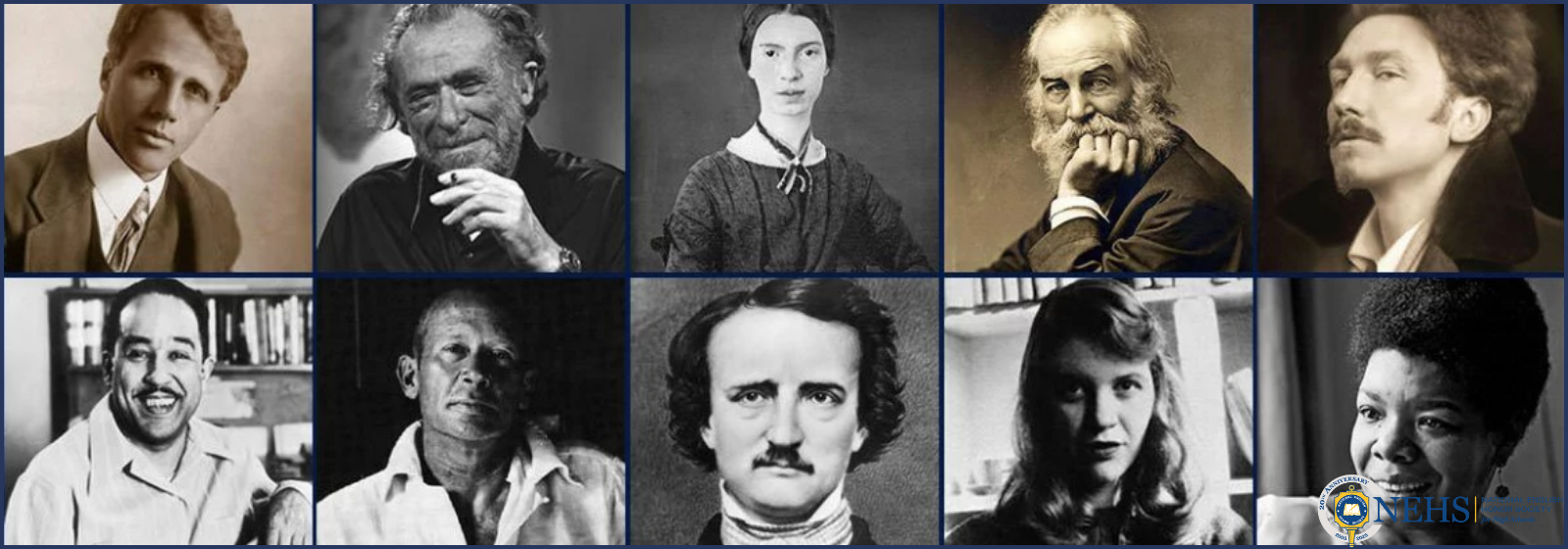
Author Rumaan Alam states that the modern-day objection to literature, most specifically poetry, “springs from skepticism towards art’s increasing dependence on technology.” “It feels suspect,” he says, “Because we’re still hostage to this romantic ideal of a poet with a scroll and a quill in the cold attic somewhere, and that’s not how it is anymore.” Perhaps poetry that transcends the 21st century has, too, become absorbed by the “insta-farming,” self-aggrandizing lens of social media. When we discuss poets such as Langston Hughes, T. S. Elliot, and Emily Dickinson, their intelligence is looked at through a dusty, divisive lens, with many appreciating their unfiltered authenticity. In contrast, others are hypercritical of the dated language. Very similarly, modern poets who primarily gain readership from social media, like Rupi Kaur and Amanda Gorman, are both praised for their utilization of the platform while simultaneously being condemned for it, with their works being criticized as “watered down” and “easily digestible.” In 2025, it seems there is no way for any poetry to appeal to everyone.
The impossibility of universal approval and acceptance in the modern political and social climate can feel like the brick tied to the legs of artistry and self-expression, suffocating and dimming its light. However, these feelings of overwhelming criticism are not new to poetry as an art form. Ben Lerner, author of “The Hatred of Poetry,” described the cultural view of poetry as overly critical, saying, “You’re moved to write a poem, you feel called upon to sing, because of that transcendent impulse. But as soon as you move from that impulse to the actual poem, the song of the infinite is compromised by the finitude of its terms.” Despite enhancing critical voices through social media, poetry has long been penetrated by voices of judgment.
One thing stands unwaveringly true: poetry is the bridge between my experiences and yours. Whether it be the powerful words of Maya Angelou or the easily accessible yet impactful words of one of my peers online, the consumption of poetry unites all corners of the world despite the differences that have become increasingly apparent in the political landscape of 2025. No matter the year, the human fight for understanding perseveres, meaning that poetry will always have the means to be created.

Sophia Francis Bridgers is an 18-year-old student at Batesville High School in Batesville, AR. She has been a member of her NEHS chapter for two years, serving as the Public Relations Chair her senior year. She has also served as one of six Arkansas State Thespian Officers for 2024-2025. She is an avid arts enthusiast, often writing poetry and submitting it to scholarship programs, like the Arkansas Thea Scholarship, where she received 5th place for her poem “Starlinked.” Beyond English, she is passionate about theatre, choir, and cheerleading. She hopes to one day have her poetry published. Sophia will be attending Hendrix College and majoring in journalism, focusing on public relations.

McKenzie Marie Treat is a 2025 senior in Batesville, AR. A member of NEHS for two years, she served as the chapter Photographer for her senior year. Diligent and affable, she was a Class Officer and a member of the Student Council. She is musically inclined, having held the position of Percussion Captain for two years. McKenzie proudly represented National Art Honors Society as president. Her pieces have been showcased at Lyon College where she received third and fourth place awards for the BAYA juried exhibit in 2024. McKenzie hopes to pursue her artistic career by attending Kansas State University and majoring in landscape architecture.
National English Honor Society
The National English Honor Society (NEHS), founded and sponsored by Sigma Tau Delta, is the only international organization exclusively for secondary students and faculty who, in the field of English, merit special note for past and current accomplishments. Individual secondary schools are invited to petition for a local chapter, through which individuals may be inducted into Society membership. Immediate benefits of affiliation include academic recognition, scholarship and award eligibility, and opportunities for networking with others who share enthusiasm for, and accomplishment in, the language arts.
America’s first honor society was founded in 1776, but high school students didn’t have access to such organizations for another 150 years. Since then, high school honor societies have been developed in leadership, drama, journalism, French, Spanish, mathematics, the sciences, and in various other fields, but not in English. In 2005, National English Honor Society launched and has been growing steadily since, becoming one of the largest academic societies for secondary schools.
As Joyce Carol Oates writes, “This is the time for which we have been waiting.” Or perhaps it was Shakespeare: “Now is the winter of our discontent made glorious summer . . .” we celebrate English studies through NEHS.
National English Honor Society accepts submissions to our blog, NEHS Museletter, from all membership categories (students, Advisors, and alumni). If you are interested in submitting a blog, please read the Suggested Guidelines on our website. Email any questions and all submissions to: submit@nehsmuseletter.us.
