
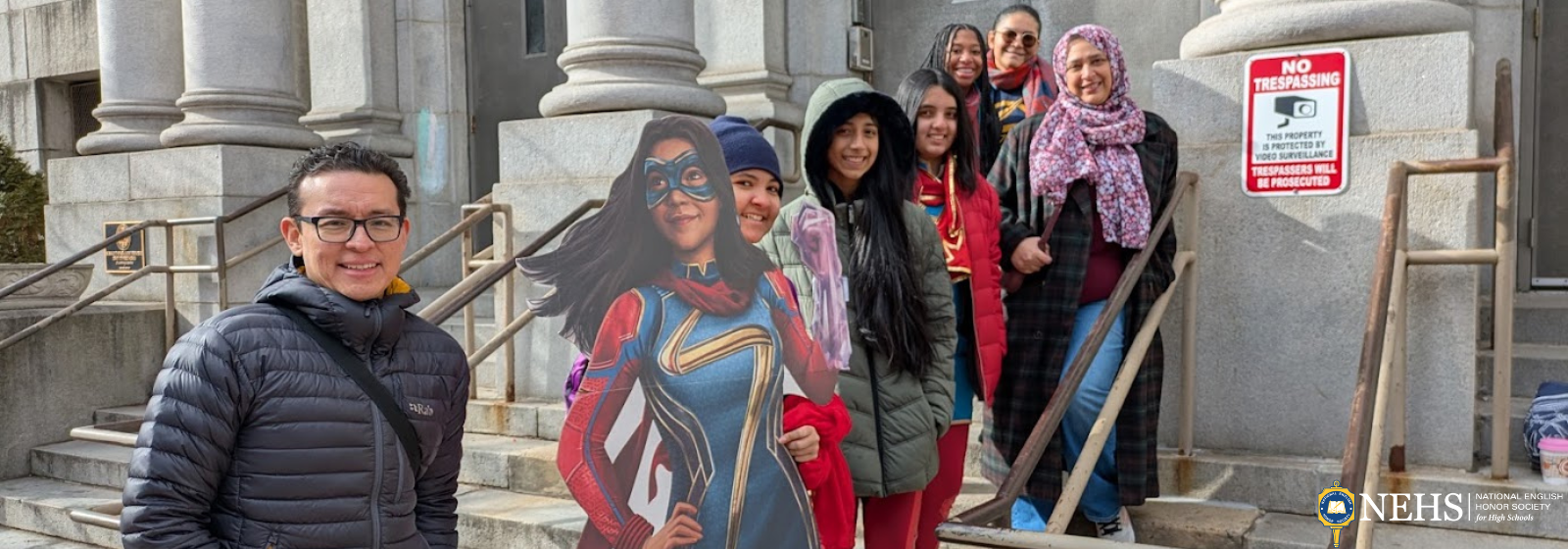
The Kamala Korps on the steps of McNair Academic with author Saadia Faruqi (in floral headscarf), McNair staff Mr. Jose Avegno, and a cardboard cutout of Ms. Marvel. (Photo: Holly Smith)
This week’s blog, by Aastha Tiwari and Maia Ceraso, seniors at McNair Academic High School in Jersey City, NJ, explores the expectations placed on Kamala Khan, Marvel’s Muslim Pakistani-American teenage superhero and Jersey City’s own hometown hero. Tiwari and Ceraso consider why marginalized characters are often expected to represent entire cultures and communities, and why supporting diverse representation may require us to embrace complexity rather than demand a single “authentic” experience.
An Impossible Burden
Imagine if, one day, your unremarkable high school suddenly became the face of Marvel’s newest teenage superhero. That’s exactly what happened in Jersey City during summer 2022, where we saw our school reimagined as Kamala Khan’s own in the MCU’s newest show, Ms. Marvel.
Kamala Khan, also known as Ms. Marvel, is the only superhero in mainstream media who’s from Jersey City. She’s a teen who attends Coles Academic High School, the fictional version of McNair (located on Coles Street). She is one of only a dozen Muslim superheroes, and one of just a few who are Pakistani. Across the world there are over 2 billion Muslim-identifying people, and 250 million Pakistanis, while in the Marvel Universe, there are only three Pakistani superheroes—Kamala Khan being the most prominent.
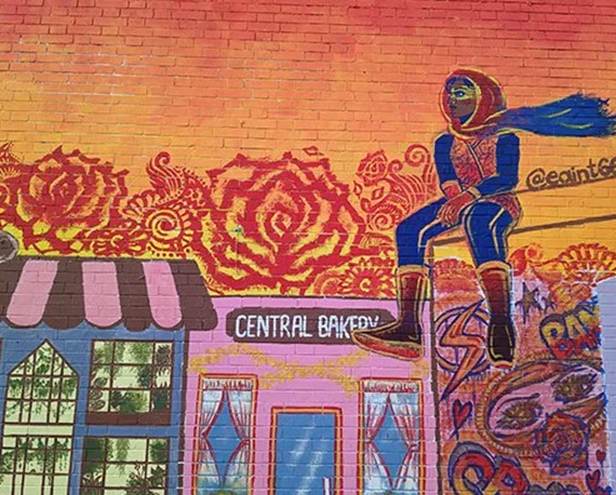
Marvel should be praised for its representation of several frequently marginalized groups. Ms. Marvel should be supported by fans who believe that representation and diversity matter. She should be celebrated for portraying authentic cultural practices and the struggles that come with being a first-generation teen.
But she isn’t.
Not that she doesn’t have fans, she does. For many, Khan’s an icon who reflects fans’ lived experiences. Even still, Khan receives immense criticism. Many critiques boil down to a dislike for “wokeness,” and “forced diversity,” and many come from members of the very marginalized groups Ms. Marvel represents.
Many enthusiasts are angry or conflicted and feel that Khan doesn’t accurately represent the Muslim and Pakistani experiences. Some criticisms are that she is not “Muslim enough.” A prevalent complaint is that she is not portrayed in a headscarf, used as proof that she’s not representative of “average Muslims.”
Some viewers criticize the portrayal of her family, saying it lacks any sort of realism for “actual Muslims,” to relate to. Still others don’t like the portrayal of her mosque and the “liberalism” of its teachers, asking, “Did an actual Muslim write this comic?”
One Quora user even commented, “As I said, she’s Muslim in name only; with whom only the Tumblr/Twitter using ‘cultural Muslim’ teenagers would be able to identify.”
On the other hand, some criticize her for being too Muslim. They point to scenes where her religion is the focus, such as when she can’t eat hot dogs, as they contain pork, which Islam prohibits.
Expecting one character to portray the experiences of a myriad of people is unfair. It’s impossible. Such a character is held to a higher standard than those in more privileged groups. They must avoid stereotypes while also representing entire groups.
This often results in them being watered down to relate to as many people as possible, morphing into “inauthentic” and unrelatable depictions.
In contrast, characters representing dominant, privileged groups are unlikely to be criticized for their personal identity rather than their literary merit, as those corresponding audiences have always had a plethora of characters to look to for representation. Superhero groups like the Avengers and the Justice League, for example, were historically started and expanded with only white characters. As such, their representations of a specific race could be more nuanced. That same responsibility is infinitely harder for the handful of characters with marginalized identities in modern media.
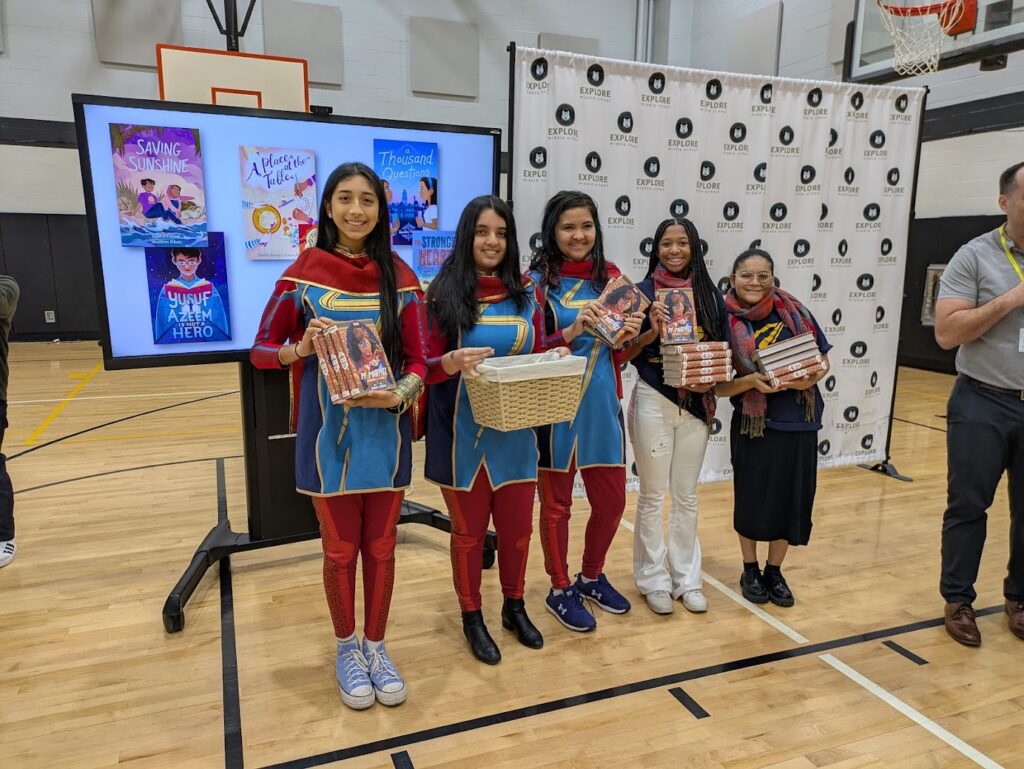
Despite the immense critique, Jersey City communities have still found resonance with their hometown hero. Our Chapter Advisor, Holly Smith, in coordination with local organizations and school clubs, facilitated a visit from the author, Saadia Faruqi, to the Jersey City Public Library for a book talk and signing event. Students from Explore Middle School and McNair High School listened eagerly as Faruqi spoke about her latest young adult release, answering questions about Kamala Khan’s newest adventure to Lahore, Pakistan in Ms. Marvel: Remnants of the Past. The event was an overwhelming success, with attendees remarking on their appreciation for the character representing their city in a well-known superhero league such as the Avengers.
Clearly, the disparities in the number of fictional characters representing different identities across media are gradually becoming more equitable. We’re seeing more characters from more diverse cultures and experiences in the mainstream.
Even so, until this inequality is fully addressed, we as consumers of media should be more kind toward the characters we critique so heavily for their unique interpretation of a culture. This is not to say that characters of marginalized backgrounds should be held above criticism or to a lower standard than their privileged counterparts; discussions about whether characters perpetuate stereotypes or faithfully depict cultures are important. However, if we overcriticize a character simply because we don’t personally relate to them, artists and writers will be less inclined to create more of them for fear of backlash or low sales. By showing support for their existence, we can signal that we want more of these characters, inspiring further creation of more diverse interpretations of identities.
Additional Reading
Article written by McNair NEHS Chapter Advisor Holly Smith on Ms. Marvel’s impact in Jersey City: Jersey City Ms. Marvel heroine is Muslim, brown, and teen — PUBLIC SQUARE

Aastha Tiwari is a senior at McNair Academic High School in Jersey City, NJ. She currently serves as the Managing Editor of the McNair Academic National English Honor Society, as well as the Co-Tutoring Coordinator for the Jersey City Free Public Library and co-secretary of her school’s Future Business Leaders of America chapter. In the summer, Aastha coordinates with Maia on the Jersey City Black Comic Con Teen Board while also volunteering at Symposia, a local non-profit bookstore. In her free time, you can find her watching true-crime documentaries or crocheting new clothing.

Maia Ceraso is a senior at McNair Academic High School (also known as Coles Academic) in Jersey City, NJ. She has served as the Editor-in-Chief for the McNair National English Honor Society since her junior year. Outside NEHS, she is also the co-president of Kamala Korps, a club at her school that plans community events showcasing diversity and representation. Maia is a Girl Scout, as well as a member of her school’s Student Council and Mock Trial team. She and Aastha serve on the first Jersey City Black Comic Con Teen Board. She is highly interested in pursuing a career as a Civil Rights attorney and hopes to publish a book one day. In her free time, she loves to write, draw, and watch whodunits.
National English Honor Society
The National English Honor Society (NEHS), founded and sponsored by Sigma Tau Delta, is the only international organization exclusively for secondary students and faculty who, in the field of English, merit special note for past and current accomplishments. Individual secondary schools are invited to petition for a local chapter, through which individuals may be inducted into Society membership. Immediate benefits of affiliation include academic recognition, scholarship and award eligibility, and opportunities for networking with others who share enthusiasm for, and accomplishment in, the language arts.
America’s first honor society was founded in 1776, but high school students didn’t have access to such organizations for another 150 years. Since then, high school honor societies have been developed in leadership, drama, journalism, French, Spanish, mathematics, the sciences, and in various other fields, but not in English. In 2005, National English Honor Society launched and has been growing steadily since, becoming one of the largest academic societies for secondary schools.
As Joyce Carol Oates writes, “This is the time for which we have been waiting.” Or perhaps it was Shakespeare: “Now is the winter of our discontent made glorious summer . . .” we celebrate English studies through NEHS.
National English Honor Society accepts submissions to our blog, NEHS Museletter, from all membership categories (students, Advisors, and alumni). If you are interested in submitting a blog, please read the Suggested Guidelines on our website. Email any questions and all submissions to: submit@nehsmuseletter.us.
