
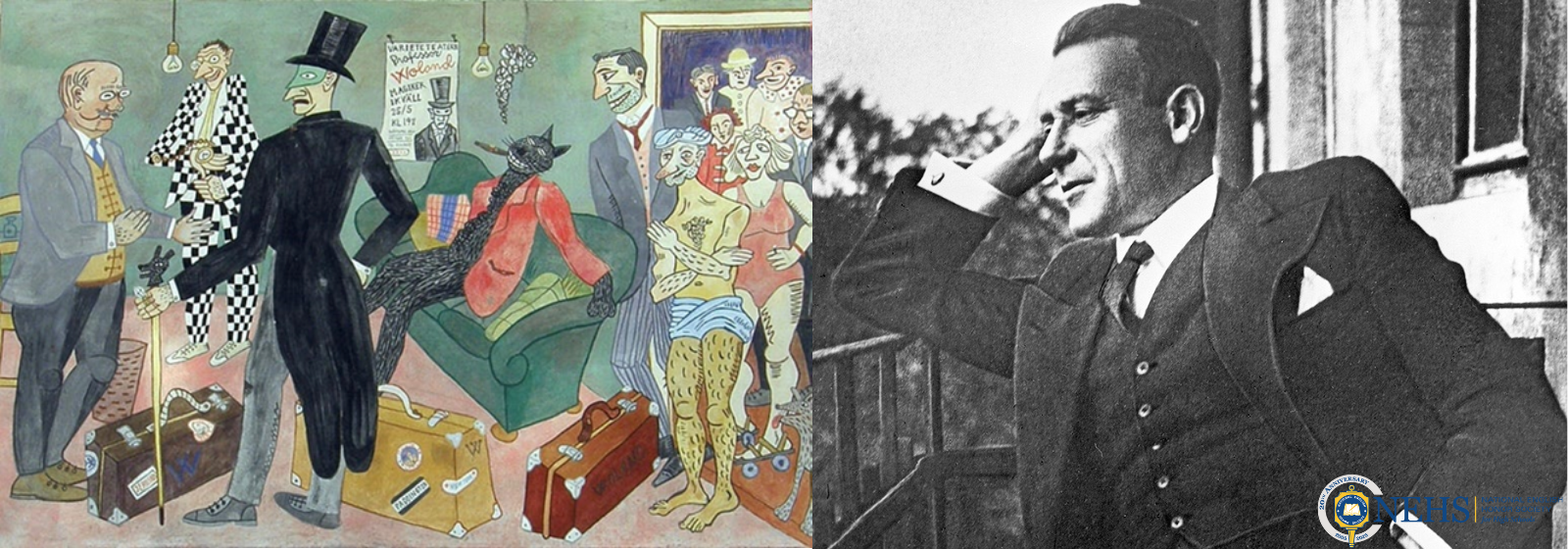
May marks the birth of Mikhail Bulgakov—born May 15, 1891—a writer whose work continues to mystify and inspire nearly a century later. In this thought-provoking blog, Kamiliya Aumiller, a senior at The Middle College at Austin Peay State University, offers a vivid exploration of Bulgakov’s most famous novel, The Master and Margarita. Her piece is a celebration not only of Bulgakov’s literary craft but of the enduring power of authors to challenge reality and reimagine the possible.
The Sunflower Oil is Spilt
A journey through time, lives, and revelations. A wild trip through Moscow and the cities and deserts of ancient Judea, The Master and Margarita is a novel that is as much a journey as it is a circular destination. Written by Mikhail Bulgakov, born in Kyiv, Ukraine, on May 15th, 1891, it is famous for its satire and penetrating humor. The narration juxtaposes two settings that alternate throughout the chapters, weaving an intricate story of the Devil’s escapades in 1930s Russia and the historical condemnation of Yeshua (Jesus).
I couldn’t believe how reading it felt like falling into a dream within a dream. It is a confusing tale that requires active participation in following the magical twists and turns of the characters, and I oftentimes felt that Bulgakov himself had no idea where the next chapter would take him. The dialogue reveals the characters to be operating on different levels of reality and oozes satire and deeply hidden turns of phrases that miss the eye on the first read through. Prepare to be thoroughly confused—but trust that you’ll be swept away by the Devil, disguised as Professor Woland, and his mischievous entourage. Together, the demon Azazello, the talking cat Behemoth, and the witch Natasha wreak havoc on Moscow, exposing the hypocrisy of the Soviet elite.
It is quite easy for the story to become lost in translation, and this depends on many factors, from your background to the publication company. Footnotes in my personal addition provided an enlightening illumination to the more obscure references. The text has layers to it, and nails something particularly hard to describe. The beauty of The Master and Margarita lies in a complete dissolution of reality that allows the narrative within the narrative to impact the real, contemporary world.
The book is far easier to understand if you don’t allow the character Master to be separated from the author Bulgakov. Practically everything that elapses in this mythical Moscow (minus the magic tricks, witches, and demons) is based on Bulgakov’s life. Just as his character does—he burnt his manuscripts in 1930 when his play, Moliere, was banned by the oppressive media companies.
He met his very own Margarita (his third wife Elena) while he was married to his second wife. Within the novel, there is a slight dig when Master recalls someone; “Mashenka . . . ” living in a house with him, but vaguely as though it doesn’t matter. Passages about Margarita were taken from his second wife’s diary, especially during their initial separation. Figures within Bulgakov’s literary circle received the same treatment in his fictional realm.
The character Bezdomny (whose name literally means “without home” in Russian) symbolizes Moscow’s housing crisis. Bulgakov, reflecting an issue felt by many at the time, wrote in his diary on September 30, 1923: “There is only one major defect in my life—the lack of my own apartment.” Comments on such societal class issues are prevalent in all of Bulgakov’s works. Berlioz, based on a real literary critic and member of a proletarian writers organization, puppets the true historic person that obviously was not meant to be sympathetic.
The book is not only a treasure trove of references to real Communist Party members, writers, and figures within Bulgakov’s circle, but also reflects his real anguish toward, and censure by, the Party. It provides distinct meditations on writing, art, love, and the agony of censorship. While British writers Orwell and Huxley imagined dystopian futures with dictators, class oppression, banned books, and censorship, Bulgakov was living it.
Under tsarist Russia, Stalinism, and Leninism, his early adulthood was divided into before and after 1917. He trained as a doctor, served time on the front lines during World War I on numerous assignments, dealt with morphine addiction, and survived Typhus all before committing his life to writing in 1919. Through his writing and art, he found his own way to transcribe the essence of his being: one of confusion and disarray. Scattered with losses and lost aspirations, Bulgakov’s life is one that reflects rebellion and revolution. His writing oscillates between grotesque, ribald, and excitement with scenes of pathos and extreme delicacy. Sympathizing with the Devil, vindicating a mother forced to abort her child, reuniting estranged lovers through war and every turmoil life throws is no easy task. And yet Bulgakov wrestles with these eternal problems and battles between good and evil. It is a luxuriously crude blend of the fantastical and mundane shaped by his masterful prose.

Kamiliya Aumiller is a senior graduating in May 2025 from The Middle College at Austin Peay State University, TN. A member of NEHS for two years, she has participated in the Intellectual Freedom and Common Reader challenges. She also served as secretary in her junior year and president in her senior year of Middle College’s Key Club. She has had five haikus published in the Asahi Shimbum Haikuist Network and revels in memorizing poems and reading classics. Beyond literature, she is an avid rock climber and backpacker and enjoys mountain biking and hiking mountains strictly to eat PB&Js at the summit. In November 2024, she presented her chemistry research project on methylxanthine caffeine in acetaminophen over-the-counter drugs at the APSU Research Symposium. She aspires to continue her biochemistry pre-med research at Vassar College.
National English Honor Society
The National English Honor Society (NEHS), founded and sponsored by Sigma Tau Delta, is the only international organization exclusively for secondary students and faculty who, in the field of English, merit special note for past and current accomplishments. Individual secondary schools are invited to petition for a local chapter, through which individuals may be inducted into Society membership. Immediate benefits of affiliation include academic recognition, scholarship and award eligibility, and opportunities for networking with others who share enthusiasm for, and accomplishment in, the language arts.
America’s first honor society was founded in 1776, but high school students didn’t have access to such organizations for another 150 years. Since then, high school honor societies have been developed in leadership, drama, journalism, French, Spanish, mathematics, the sciences, and in various other fields, but not in English. In 2005, National English Honor Society launched and has been growing steadily since, becoming one of the largest academic societies for secondary schools.
As Joyce Carol Oates writes, “This is the time for which we have been waiting.” Or perhaps it was Shakespeare: “Now is the winter of our discontent made glorious summer . . .” we celebrate English studies through NEHS.
National English Honor Society accepts submissions to our blog, NEHS Museletter, from all membership categories (students, Advisors, and alumni). If you are interested in submitting a blog, please read the Suggested Guidelines on our website. Email any questions and all submissions to: submit@nehsmuseletter.us.
