
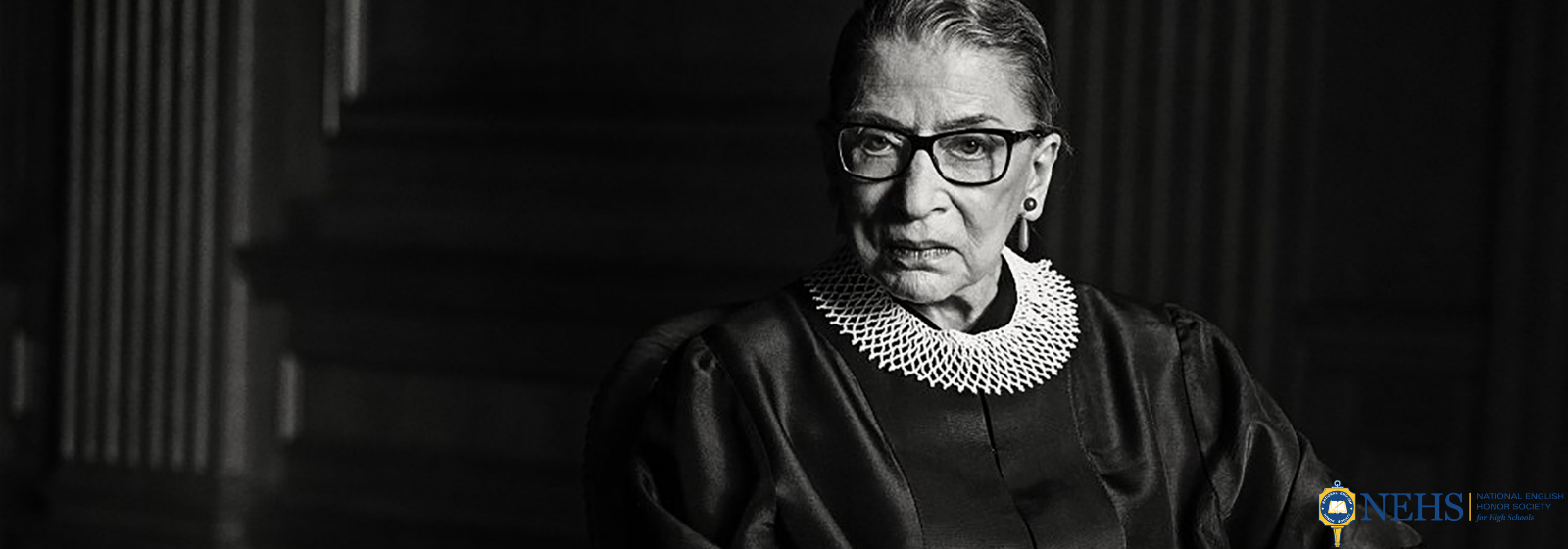
As NEHS continues to celebrate Women’s History Month, student members around the world are reflecting on the women whose stories have shaped their understanding of leadership, courage, and justice. In this week’s blog, Aurora Jacobs, from Belleville East High School, IL, shares how reading Ruth Bader Ginsburg: A Life transformed the way she understands her own voice and her potential as a leader. Aurora reflects on how learning about the life and legacy of Ruth Bader Ginsburg helped her see that leadership does not always come from the loudest voice in the room. Sometimes, it emerges from careful listening, thoughtful conviction, and the courage to speak out when it matters most.
(T)ruth: Justice Ginsburg’s Prowess and the Need for Female Leadership
Books have been a source of inspiration and peace for me since I was a child. They are the medium in which I first came in direct contact with feminism. While reading Jane Sherron De Hart’s Ruth Bader Ginsburg: A Life, I discovered a slight, introverted woman like me. I spent much of my early academic career criticizing myself for rarely being the first to raise my hand or hesitating to share my insight. Being a self-contained young girl who had strong opinions on historical and political topics, I struggled with contemplating speaking out and being met with constant scrutiny by male peers. And then I found Ruth, a woman who climbed to the highest court in the United States—someone who possessed the same quiet demeanor I do.
Ruth Bader Ginsburg: A Life makes its way through RBG’s lifetime of public service. It vividly describes how her life experiences led her to sitting on the Supreme Court bench. The most meaningful part of the biography for me was not only her landmark decisions, but her personality and mannerisms. When many legal professionals were dramatic or outspoken, RBG kept to herself. Ruth’s introverted qualities are highlighted as examples of her careful measuring and considerate demeanor; she reads, and listens to the entire picture, to ensure she can give the best response.
Having always been the reserved kid in class, this book resonated with me. RBG’s resolve and manner inspired an epiphany that led me to re-evaluate my self-worth. I took my time to deeply consider my peers’ thoughts before weighing in—confidently, having gathered all the facts from both my teachers and classmates. I also became comfortable with taking on leadership roles, when before I would have trembled at the thought of power. My newfound truth, that my introverted personality is not an ailment, filled me with ambition and eagerness for my own adult life.
With this new confidence, I felt more pride in taking on new interests. I proudly joined the school newspaper, when before I would have been nervous about offering my ideas to new people. I proudly read history and political science books, when I previously would have worried about being labeled a nerd. And I proudly plan to continue to be myself: a driven, introspective young woman who leads with empathy and integrity. My growth to become comfortable with someone who is paralleled with Ruth’s quiet, yet powerful and determined voice.
De Hart’s biography left an impact on me that will forever influence my future endeavors. It helped me view my development from childhood to young adulthood in a new light and encouraged me to pursue my passions of history and political science in college. Ginsburg helped me understand the desperate needs that face the country: newfound leadership and ideas that can inspire citizens. This need began to be fulfilled when RBG’s generation fearlessly entered male dominated fields, and their legacy will continue with me. They established a new social norm. A social norm that means women belong.
Women’s History Month serves as a reminder of all the contributions that fifty percent of the population have made, along with every hindrance and challenge that women have had to overcome, to gain respect. When women are ignored, progress is rejected. In truth, all women, both extroverted and introverted, require a platform to be heard and seen as the remarkable and valuable people they are.

Aurora Jacobs is a senior at Belleville East High School, where she is a member of the Literary Lancers Chapter of the National English Honor Society. She lives in Belleville, IL, with her father, brothers, and three cats. Outside of school, her interests include coaching youth volleyball, supporting women’s sports, and learning everything she can about literature and social sciences. She is an avid reader and history buff and especially enjoys reading biographies of influential historical and political figures, especially if they are women. In the fall, Aurora will attend Illinois State University where she plans to major in history education and eventually plans on attending law school.
National English Honor Society
The National English Honor Society (NEHS), founded and sponsored by Sigma Tau Delta, is the only international organization exclusively for secondary students and faculty who, in the field of English, merit special note for past and current accomplishments. Individual secondary schools are invited to petition for a local chapter, through which individuals may be inducted into Society membership. Immediate benefits of affiliation include academic recognition, scholarship and award eligibility, and opportunities for networking with others who share enthusiasm for, and accomplishment in, the language arts.
America’s first honor society was founded in 1776, but high school students didn’t have access to such organizations for another 150 years. Since then, high school honor societies have been developed in leadership, drama, journalism, French, Spanish, mathematics, the sciences, and in various other fields, but not in English. In 2005, National English Honor Society launched and has been growing steadily since, becoming one of the largest academic societies for secondary schools.
As Joyce Carol Oates writes, “This is the time for which we have been waiting.” Or perhaps it was Shakespeare: “Now is the winter of our discontent made glorious summer . . .” we celebrate English studies through NEHS.
National English Honor Society accepts submissions to our blog, NEHS Museletter, from all membership categories (students, Advisors, and alumni). If you are interested in submitting a blog, please read the Suggested Guidelines on our website. Email any questions and all submissions to: submit@nehsmuseletter.us.
