
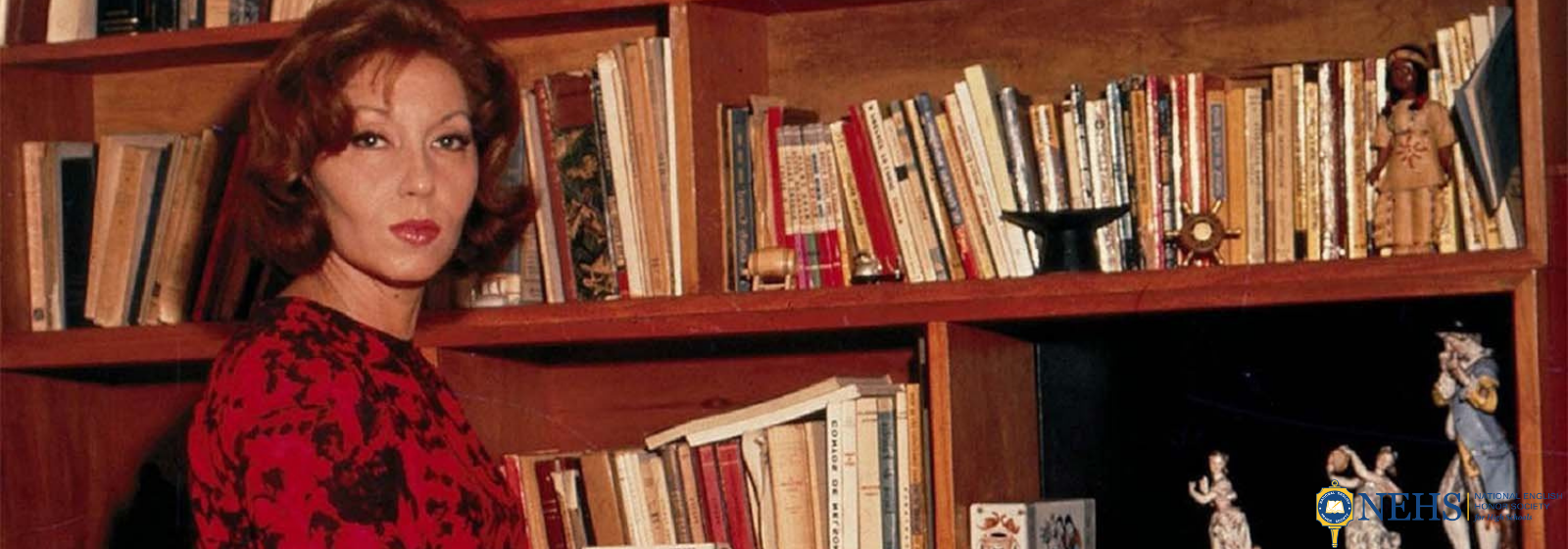
What does it mean to find yourself through language? Few writers embody this more than Clarice Lispector. Born in Ukraine and raised in Brazil after her family fled anti-Jewish violence, Lispector wrote in Portuguese as an adopted language yet became one of the country’s most influential literary voices. Her novels are celebrated for their unconventional style and their exploration of what it means to exist, to feel, and to belong.
Student writers from Milken Community School, CA, Camryn Banafsheha, Juliana Leb, and Leah Soormaghen examine how Lispector transformed personal hardship into a literary voice that continues to resonate. Their blog invites us to consider how storytelling can serve as a means of survival, connection, and self-understanding.
Writing the Self: Clarice Lispector and the Power of Literature to Transform Identity
Language extends far beyond simple formations of letters; the way in which each person expresses themself to others is a crucial part of human identity. Without literature, life is two-dimensional, lacking meaning and purpose. In a sea of talented writers and creators, Clarice Lispector stands out as an important figure. Through her unique life story and strong portfolio, she exemplifies the power of literature. A Brazilian woman, originally born in Ukraine in 1920, Lispector proves that literature is a tool that can strengthen someone’s identity in moments of hardship and loneliness. It is a bridge that can create connections between people who may not even speak the same language.
Lispector was a young child when her family escaped violent anti-Jewish pogroms in Eastern Europe and immigrated to Brazil. Growing up in an unfamiliar environment, she learned to speak Portuguese and was forced to integrate into an unfamiliar world. Although she spent her early years immersed in Brazilian culture, she always felt like she didn’t belong and labeled herself as an immigrant, an “outsider” who couldn’t fit in. Rather than succumbing to the feeling of isolation, she used literacy to construct a new sense of self that comforted her. She turned the hardships she faced into an impactful life’s work, representing the Jewish diaspora experience and giving a voice to all “outsiders” around the world. Forging a new world through her words and creativity became the focus of her life’s journey. Lispector’s legacy now inspires us to take discomfort and turn it into something unforgettable.
Although Portuguese was not her first language, Lispector became one of Brazil’s most innovative writers. Perhaps the reason her works are so highly regarded is because she approached writing from a unique lens: rather than highlighting action, she prioritized the portrayal of thoughts and feelings. She mastered her craft of molding literature into a mode of expression and therapy, both for herself and her audience. With each text, The Hour of the Star or Near to the Wild Heart or The Passion According to G.H., she built her own genre of literature. This genre is different from all others: it is about human experience and real, raw emotions. As a result of her bravery and innovation, a new path has been paved for authors. A path in which a more crucial element outshines plot and rhetoric: emotion.
Regarding her ethnicity, she successfully incorporated her background into the themes of her writing. A strong search for belonging and purpose is key to her style, shining a light to immigrant experiences on a global scale. Her Jewish Sephardic roots are engraved in her stories, revealing how large historical events impact civilians’ everyday lives. Overall, Lispector recreated herself as a writer by taking inspiration from her own life and ethnic identity and building new stories. She ultimately used writing as a tool to process her experiences and move through the most difficult moments in life. Following her lead, many people now look to writing as a tool for survival and emotional relief.
While the world has been blessed with many inspirational writers throughout history, Clarice Lispector stands out. Lispector simply approached writing differently. For her, it was not a task, it was an outlet. Her pen and paper were her favorite place, one to which she could turn whenever she needed to escape the harsh realities of her life. She reinvented literature by placing emphasis on emotion and raw humanity, rather than polished fairytale stories. Her work is real, relatable, and representative of the human experience. Through her words, she gained clarity. Through her writing, we all feel understood.

Camryn Banafsheha is an eleventh-grade student at Milken Community School. She is passionate about writing, and her work has been published in the Jewish Journal and Harvard-Westlake Chronicle. Beyond literature, she enjoys teaching piano, leading teen nonprofit groups, and learning new languages. She hopes to continue sharing her work with others and growing as a writer.

Juliana Leb is an eleventh-grade student at Milken Community School. A dedicated student, Juliana balances academic excellence with commitment to service, spending her time tutoring underprivileged children and improving their literacy skills. She also enjoys reading, writing, and playing basketball. She looks forward to continuing to grow as a writer and using her voice to uplift and inspire others.

Leah Soormaghen is a twelfth-grade student at Milken Community School. She is passionate about using writing as a tool for leadership, service, and community engagement. In her free time, she enjoys reading, painting, and exercising. Beyond the classroom, she has submitted her creative work to several national competitions.
National English Honor Society
The National English Honor Society (NEHS), founded and sponsored by Sigma Tau Delta, is the only international organization exclusively for secondary students and faculty who, in the field of English, merit special note for past and current accomplishments. Individual secondary schools are invited to petition for a local chapter, through which individuals may be inducted into Society membership. Immediate benefits of affiliation include academic recognition, scholarship and award eligibility, and opportunities for networking with others who share enthusiasm for, and accomplishment in, the language arts.
America’s first honor society was founded in 1776, but high school students didn’t have access to such organizations for another 150 years. Since then, high school honor societies have been developed in leadership, drama, journalism, French, Spanish, mathematics, the sciences, and in various other fields, but not in English. In 2005, National English Honor Society launched and has been growing steadily since, becoming one of the largest academic societies for secondary schools.
As Joyce Carol Oates writes, “This is the time for which we have been waiting.” Or perhaps it was Shakespeare: “Now is the winter of our discontent made glorious summer . . .” we celebrate English studies through NEHS.
National English Honor Society accepts submissions to our blog, NEHS Museletter, from all membership categories (students, Advisors, and alumni). If you are interested in submitting a blog, please read the Suggested Guidelines on our website. Email any questions and all submissions to: submit@nehsmuseletter.us.
