

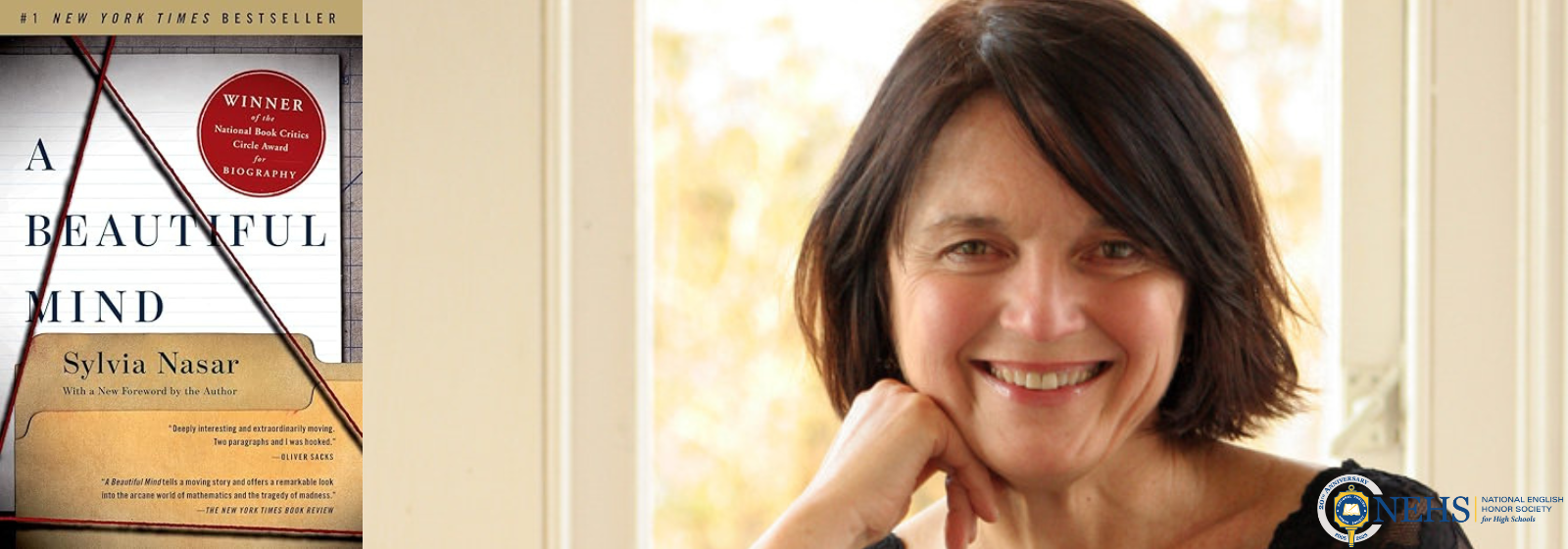
In his reflection on A Beautiful Mind by Sylvia Nasar (first published in June 1998), NEHS student Jimin Han, from QSI Shenzhen in China, explores the life of mathematician John Nash through both a personal and analytical lens. Jimin uses Nash’s story as a mirror for the modern student experience—highlighting the pressures of achievement, the value of resilience, and the impact of human connection. Read on to find out how Nash’s journey toward rediscovery resonates far beyond mathematics, offering insights into self-awareness, the perils of ambition, and the benefits of emotional growth.
Between Equations and Emotions: Rediscovering the Self
Our life often operates in a state of equilibrium: in that sense, it is very similar to the concept of game theory pioneered by John Forbes Nash Jr. in the 20th century. Many of us, as students, are familiar with the idea of the Nash Equilibrium when making and balancing everyday decisions, particularly those where others’ choices influence ours. Ironically, the “beautiful mind” that majorly contributed to the theory was less steady. In the biography A Beautiful Mind, Sylvia Nasar not only introduces readers to Nash’s crucial breakthroughs in mathematics but also underscores his struggles with mental health and schizophrenia, which would heavily affect his life.
His story begins in West Virginia, where he spent his early years and developed an interest in academia after a lonely childhood. Nasar describes Nash as a solitary, eccentric, figure whose intellectual capabilities isolated him from his surroundings. Nash earned his fame in mathematics following his invention of the Nash Equilibrium at only twenty-one, yet his quirkiness kept people out of his social circle, and he invested more of his time in studying mathematics. As students, we also sometimes find ourselves stuck between pursuing our passion and paying attention to personal relationships. For us, his journey serves as a useful reminder to keep in mind our relationships and the costs that they may face as we pursue greatness.
His delusions and schizophrenia also grew with his worldwide celebrity status. Despite some efforts to reconcile his genius with enduring mental illness, his delusions, hospitalizations, and persecution by government agencies, deeply affected his life. Some of us are pressured to live up to the expectations of others: Nash’s developing illness seems to highlight the pressure. His struggle led me to the understanding that success does not necessarily translate into fulfillment. We often carelessly equate outward achievements with internal happiness, but his mental health issues led me to critically reconsider the fragility of the human mind.
Apart from his struggle, what really stood out to me was his wife’s continuous support under any circumstance. She remained committed to Nash, guiding him through his worst periods of schizophrenia. Her presence and devotion to Nash taught me the importance of having acquaintances, family, or friends around us at times when we feel that we are losing ourselves. With her care and Nash’s resilience, he miraculously returned to academia and won the Nobel Prize at sixty-six for his contributions to game theory. For Nash, recovery was not rebuilding his academic status; rather, he rediscovered his true sense of self. Nash’s surprising recovery from schizophrenia certainly did not happen overnight, nor was it linear. His eventual accomplishment after an enduring period of setbacks showcases the long-term benefits of facing our challenges.
Reflecting on Nash’s life, we are reminded that tackling and overcoming a series of ordeals is a pivotal step we will face before discovering who we truly are. Defined by his groundbreaking accomplishment in social science as well as his equally challenging mental struggles, which he overcame through resilience and the help of others, Nash’s journey tells us how facing our inner self can lead to personal growth. As we contend with countless plights in our everyday lives, although often not as extreme as those of Nash, we may also find the opportunity to rediscover our true identity.

Originally from Bundang, South Korea, Jimin Han has been living in Shenzhen since 2017. He is fluent in Korean and English, with intermediate proficiency in Chinese. He loves learning about English writing, particularly research, and has been serving as Vice President of the NEHS QSI Shenzhen chapter, leading various school events as a senior member. Jimin is also passionate about diverse topics in mathematics and is into startups. When he is not exploring the latest in IT or working on mathematics, he enjoys playing and watching football (a big fan of Manchester United), playing the viola in local orchestras, golfing with his parents, and playing the video game Clash Royale with his friends. He is excited about the coming years of college in the United States, where he will be studying engineering (mechanical or electrical), and the invaluable opportunities they will bring.
National English Honor Society
The National English Honor Society (NEHS), founded and sponsored by Sigma Tau Delta, is the only international organization exclusively for secondary students and faculty who, in the field of English, merit special note for past and current accomplishments. Individual secondary schools are invited to petition for a local chapter, through which individuals may be inducted into Society membership. Immediate benefits of affiliation include academic recognition, scholarship and award eligibility, and opportunities for networking with others who share enthusiasm for, and accomplishment in, the language arts.
America’s first honor society was founded in 1776, but high school students didn’t have access to such organizations for another 150 years. Since then, high school honor societies have been developed in leadership, drama, journalism, French, Spanish, mathematics, the sciences, and in various other fields, but not in English. In 2005, National English Honor Society launched and has been growing steadily since, becoming one of the largest academic societies for secondary schools.
As Joyce Carol Oates writes, “This is the time for which we have been waiting.” Or perhaps it was Shakespeare: “Now is the winter of our discontent made glorious summer . . .” we celebrate English studies through NEHS.
National English Honor Society accepts submissions to our blog, NEHS Museletter, from all membership categories (students, Advisors, and alumni). If you are interested in submitting a blog, please read the Suggested Guidelines on our website. Email any questions and all submissions to: submit@nehsmuseletter.us.
