
In this week’s blog, Samantha Galarosa, Ava Gutkin, and Erika Wang from Kinnelon High School, NJ, explore the growing tension between consuming digital media and the enduring value of reading. The authors argue that reading remains essential for developing focus, critical thinking, media literacy, and empathy, reflecting some of the core aims of NEHS. Their blog not only highlights the cognitive and social benefits of reading, but also its importance to students navigating an increasingly information-saturated world.
The Vanishing Skill: Why Reading Still Matters in a Digital World
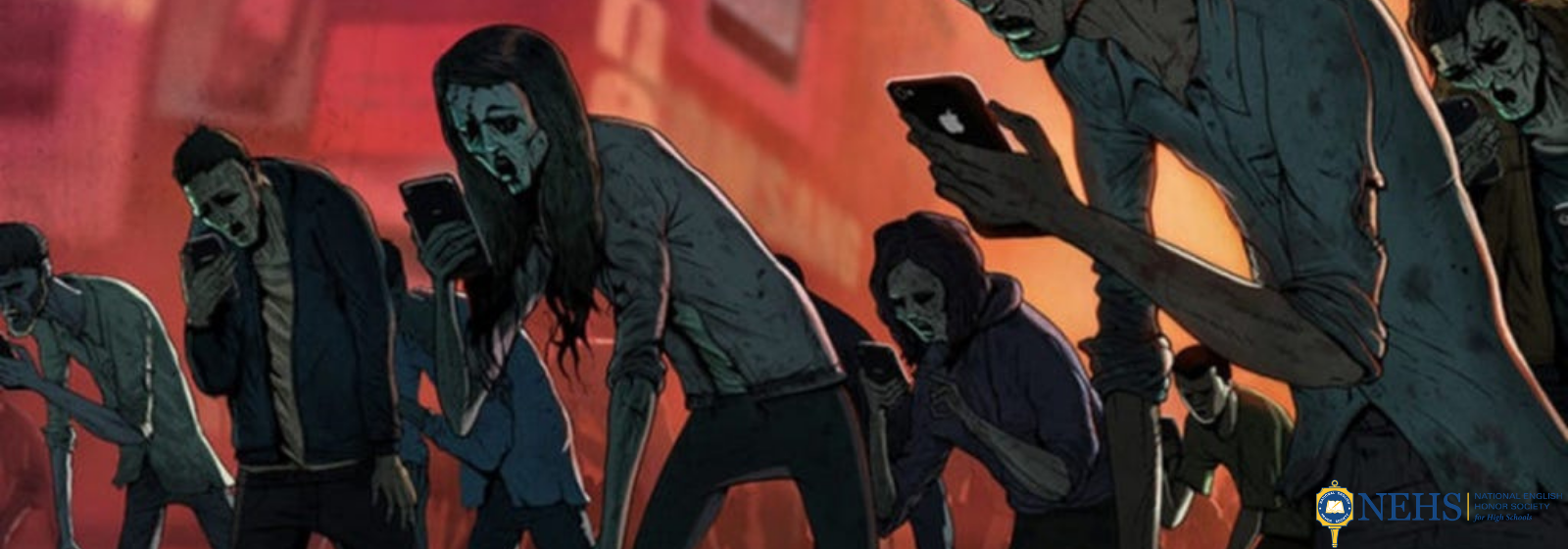
Everyone has experienced the uncomfortable silence that follows their phone dying and the stream of notifications suddenly disappears. However, this moment also reveals how dependent daily life has become on fast, digital resources. Reading, once a common and leisurely habit, has rapidly declined, and yet, it remains one of the most valuable skills in the digital world.
Unlike social media, which encourages quick engagement, reading requires sustained attention. It asks readers to slow down, process information, and engage with ideas more deeply. This contrast is evident when considering the amount of time spent on screens. More than 50% of teenagers aged 12 to 17 in the US had 4 or more hours of daily screen time. When we compared our screen times, our daily averages were 7, 10, and 12 hours, respectively, with much of that time spent switching between apps rather than engaging in a single activity. That pattern of distraction makes it difficult to focus for extended periods, which reading can rebuild.
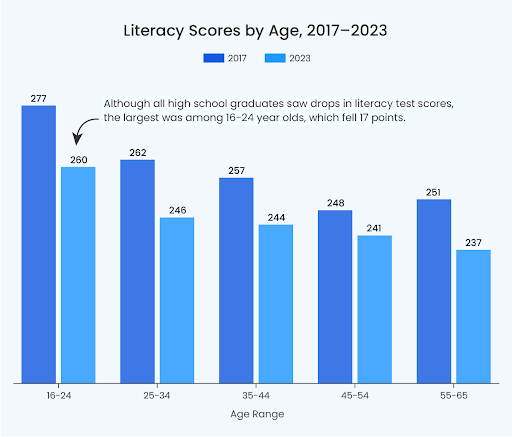
When people rely on short-form, algorithmic content, they are less likely to review sources or carefully analyze information. Reading, however, develops the necessary focus and patience to evaluate credibility and recognize bias. Additionally, illiteracy has become such a serious problem in our country that 130 million adults are now unable to read a simple story to their children. In 2022, 21% of US adults were illiterate, and 54% of adults read at a level below a sixth-grade level.
Research in cognitive science supports this connection, with studies demonstrating that consistent reading enhances attention span, memory, and problem-solving skills. Reading strengthens your cognitive activity, and if you’re already tired of reading this, your brain might need a more stimulating cognitive workout. As high school students, we need these skills to withstand the challenges of lessons, homework, and tests; however, these skills are useful at any age.
Furthermore, at a time when AI is rampant, media literacy is more important than ever. Media literacy is the ability to evaluate sources, question information, and spot bias. Research from the Stanford Graduate School of Education proved that many students struggle to separate credible sources from misleading ones on the internet. The habits strengthened through independent reading help avoid the spread of false information. Independent reading plays a critical role in strengthening these abilities and reducing the risk of misinformation.
Reading also has an important social and emotional impact. A study published by Science found that reading literary fiction improves a person’s ability to recognize and understand complex emotions. In literary fiction and many other genres, there is a hero to support and a villain to hate. This is how empathy develops, demonstrating that reading has as great an impact on our intellectual capabilities as our emotional ones.
Similarly, the real-life experiences a person has shape their outlook on the world; those they encounter through literary works expand that outlook by allowing them to live vicariously through a variety of perspectives different from their own. Many literary texts, including classical literature, reinforce this idea. For example, in Homer’s Iliad, readers are immersed in the realities of war through characters like Achilles, whose rage drives conflict, and Hector, who fights to protect his family and home. Through these perspectives, the epic reveals both the brutality of combat and the emotional weight for those involved.
Literature like this provides insight into human nature, allowing readers to understand perspectives and moral dilemmas that extend beyond their lives, and exposes them to stories they may never actually experience firsthand. By stepping into these unique perspectives through characters, readers learn to see the world through the eyes of others, cultivating a more complex understanding of the world around them.
As students, we know firsthand that reading gets a bad reputation for being a boring chore. However, you don’t need to read lengthy literary works, like War and Peace or a tragic Shakespearean play, to gain the benefits of reading. In addition to our required readings about World War II and Henry David Thoreau’s escapades in the woods, Erika read a fiction novel about Abraham Lincoln as a vampire hunter, Samantha read a news article about Tom Brady cloning his late dog, and Ava revisited her middle school novel, The Outsiders by S. E. Hinton, in anticipation of her trip to see the Broadway show. Whether it is a mystery novel, a newspaper article, or canonical literature, reading intentionally for a short period each day on topics you enjoy can improve focus, strengthen critical thinking, and expand understanding of the world.
Ultimately, reading is an essential skill in navigating the difficulties of the modern world. It supports critical thinking, strengthens cognitive skills, and fosters empathy, all qualities that are essential in a fast-paced, information-based society. The next time your phone battery dies, rather than immediately reaching for a charger, consider finding something to read instead. The benefits extend far beyond a page.

Samantha Galarosa is currently a junior at Kinnelon High School in Kinnelon, NJ. She is the school news editor of her school newspaper and part of her school’s volleyball team. In her free time, she likes to read, binge-watch TV shows, and try new foods with her friends. This is her first year in the National English Honor Society.

Ava Gutkin is a member of the class of 2027 at Kinnelon High School in Kinnelon, NJ. She is the editor-in-chief of her school paper and was selected as one of three student presentations at the 2025 Garden State Scholastic Press Association Fall Journalism Conference at Rutgers University. Outside of school, Ava enjoys volunteering with animals, writing, and painting. This is her first year in the National English Honor Society.

Erika Wang is currently a junior at Kinnelon High School in Kinnelon, NJ. She is the recording secretary for her school’s executive student council board. Outside of school, she volunteers at a Taekwondo Dojang and a food pantry, and she also likes to bake as a hobby. This is her first year in the National English Honor Society.
National English Honor Society
The National English Honor Society (NEHS), founded and sponsored by Sigma Tau Delta, is the only international organization exclusively for secondary students and faculty who, in the field of English, merit special note for past and current accomplishments. Individual secondary schools are invited to petition for a local chapter, through which individuals may be inducted into Society membership. Immediate benefits of affiliation include academic recognition, scholarship and award eligibility, and opportunities for networking with others who share enthusiasm for, and accomplishment in, the language arts.
America’s first honor society was founded in 1776, but high school students didn’t have access to such organizations for another 150 years. Since then, high school honor societies have been developed in leadership, drama, journalism, French, Spanish, mathematics, the sciences, and in various other fields, but not in English. In 2005, National English Honor Society launched and has been growing steadily since, becoming one of the largest academic societies for secondary schools.
As Joyce Carol Oates writes, “This is the time for which we have been waiting.” Or perhaps it was Shakespeare: “Now is the winter of our discontent made glorious summer . . .” we celebrate English studies through NEHS.
National English Honor Society accepts submissions to our blog, NEHS Museletter, from all membership categories (students, Advisors, and alumni). If you are interested in submitting a blog, please read the Suggested Guidelines on our website. Email any questions and all submissions to: submit@nehsmuseletter.us.
