

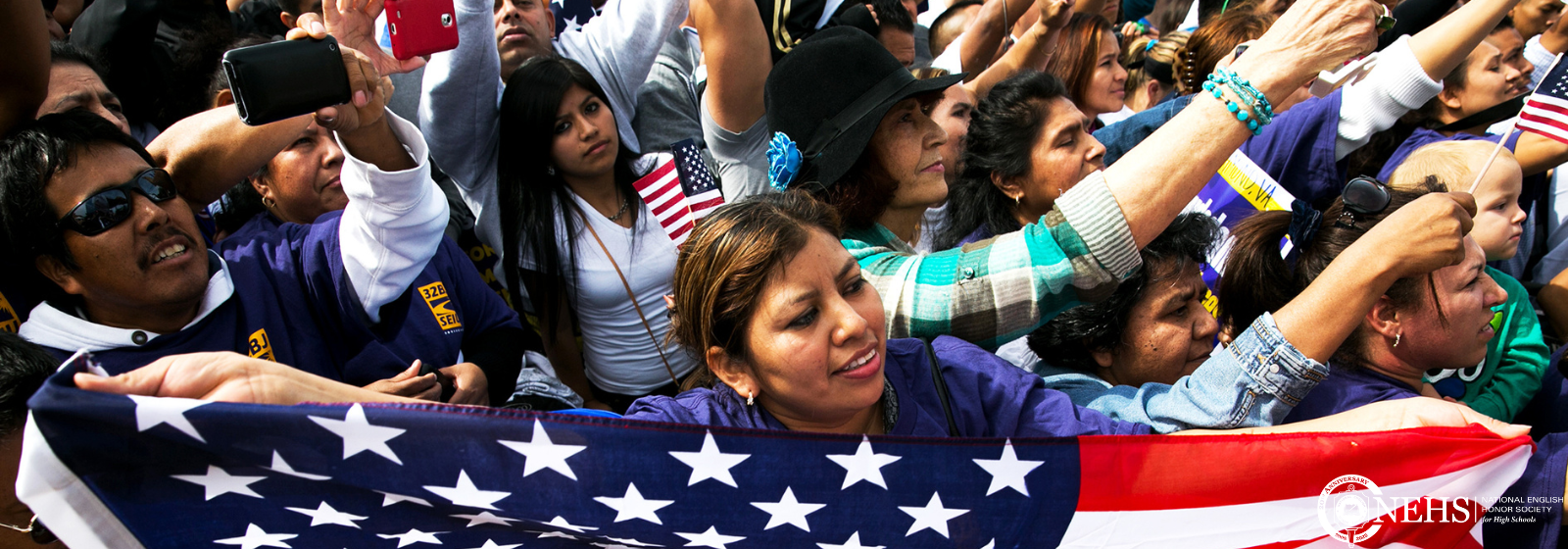
Hispanic Heritage Month has long been a time of pride, celebration, and remembrance for millions of Latine/Hispanic people in the United States. It is a moment when communities come together to honor cultural traditions, recognize historical and contemporary contributions, and affirm the resilience of those who have helped shape the nation’s past and present. Yet, in times of political tension and uncertainty, celebrations can also take on new meaning: what should be a joyful recognition of identity and heritage may need to change focus and evolve into a platform for protest, solidarity, and advocacy. In the blog below, Diego Gómez Cabrera, from PrepaTec León, Mexico, reflects on the changing significance of Hispanic Heritage Month in light of today’s political challenges.
Celebrate Hispanic Heritage Month with NEHS: join our Hispanic Heritage Month webinar with acclaimed Latine author Angie Cruz and submit NEHS scholarship applications based on How Not to Drown in a Glass of Water from September 29 – October 14.
A place to call home . . . right?
As many people know, in a couple of days, Hispanic Heritage Month will begin.
This period celebrates and appreciates the many contributions that this panethnic group has made over the years to the United States of America. During this time, many parades and festivities take place across the country to celebrate the culture and origins of almost 65.2 million people.
However, this year, things might change with the arrival of the new anti-immigration agenda which promises the largest mass deportation ever in the United States’ history, and, so far, it has stayed true to its aims. This move has caused a lot of concern among Latine and Hispanic groups, which, according to Reuters, now have a disapproval rating of Trump of over 61%. Furthermore, this rating only seems to get worse by the day when news outlets report that over a million citizens deemed “legal” may now be targeted by the US Immigration and Customs Enforcement department.
As a member of the Latine/Hispanic community, I believe this will lead to a very different Heritage Month. Unlike in previous years, this time it might not only be about celebrating, but about protesting against these new policies: Examples of this have taken place in New York City, which has seen many protests demanding “ICE out of NYC.”
I cannot help but see that the events that are happening today have some similarities to those that warranted a formal, public commemoration of Latine/Hispanic Heritage in the first place.
Latine people have been living in what is now US territory for centuries, even before the Spanish and European colonization took place. After the colonies were set up and subsequently liberated, panethnic groups were already a part of the star-spangled nation, supporting its development through advocacy work, vibrant art and culture, popular and traditional foods, and strong businesses. Moreover, the population expanded dramatically with the Treaty of Guadalupe-Hidalgo, the Treaty of Paris, and several US government-led immigration programs into the country.
Being a Latine/Hispanic person during the 19th and 20th centuries was often synonymous with mistreatment, racial oppression, and a lack of recognition, actions that led to the creation of multiple groups working to support Latine/Hispanic civil rights; these same groups came together and formed the Chicano Civil Rights Movement during the 1960s. In 1966, under President Johnson, the celebration known in the past as Latinx/Hispanic Heritage Week was created to commemorate and honor the hard work, art, traditions, and much more that these communities had brought to the nation. This event was further expanded in 1986 by President Reagan, when he determined it would last an entire month from September 15th to October 15th.
Latine/Hispanic people have been in the US since its beginning and have supported its building and consolidation as a country for centuries; they have also had to fight for their recognition inside the society but today, that recognition feels like it is being taken away when people catalogue them as “alien,” undermining the efforts made in the past for both Latine/Hispanic people themselves and the nation as a whole.
All of this, in my opinion, leads to the idea that this year’s event, meant to honor Latine/Hispanic people, will most likely be used for protest. Hispanic Heritage Month should function as a way to remember the history of our communities, our multiple identities, and our acceptance within a new society. However, when one of these factors is attacked, the event itself will shift focus from celebrating to fighting back against the injustices made.

Diego Gómez Cabrera is a seventeen-year-old senior who loves to hang out with his friends and his girlfriend. He also likes to play video games, learn new things, and overall do his best. He is known at PrepaTec Leon, Mexico, as a proficient English speaker as a result of his Cambridge and Victoria certifications and his position in the National English Honor Society. He has also participated in many events as a valuable and effective staff member; these events include organizing concerts, parades, reading clubs, and, soon, a Model United Nations event. His current focus is rooted in his love for cinema, as he has participated in multiple acting lessons and animation courses to deepen his understanding of this field. In January of next year, he will be starting his final semester of high school.
National English Honor Society
The National English Honor Society (NEHS), founded and sponsored by Sigma Tau Delta, is the only international organization exclusively for secondary students and faculty who, in the field of English, merit special note for past and current accomplishments. Individual secondary schools are invited to petition for a local chapter, through which individuals may be inducted into Society membership. Immediate benefits of affiliation include academic recognition, scholarship and award eligibility, and opportunities for networking with others who share enthusiasm for, and accomplishment in, the language arts.
America’s first honor society was founded in 1776, but high school students didn’t have access to such organizations for another 150 years. Since then, high school honor societies have been developed in leadership, drama, journalism, French, Spanish, mathematics, the sciences, and in various other fields, but not in English. In 2005, National English Honor Society launched and has been growing steadily since, becoming one of the largest academic societies for secondary schools.
As Joyce Carol Oates writes, “This is the time for which we have been waiting.” Or perhaps it was Shakespeare: “Now is the winter of our discontent made glorious summer . . .” we celebrate English studies through NEHS.
National English Honor Society accepts submissions to our blog, NEHS Museletter, from all membership categories (students, Advisors, and alumni). If you are interested in submitting a blog, please read the Suggested Guidelines on our website. Email any questions and all submissions to: submit@nehsmuseletter.us.
