

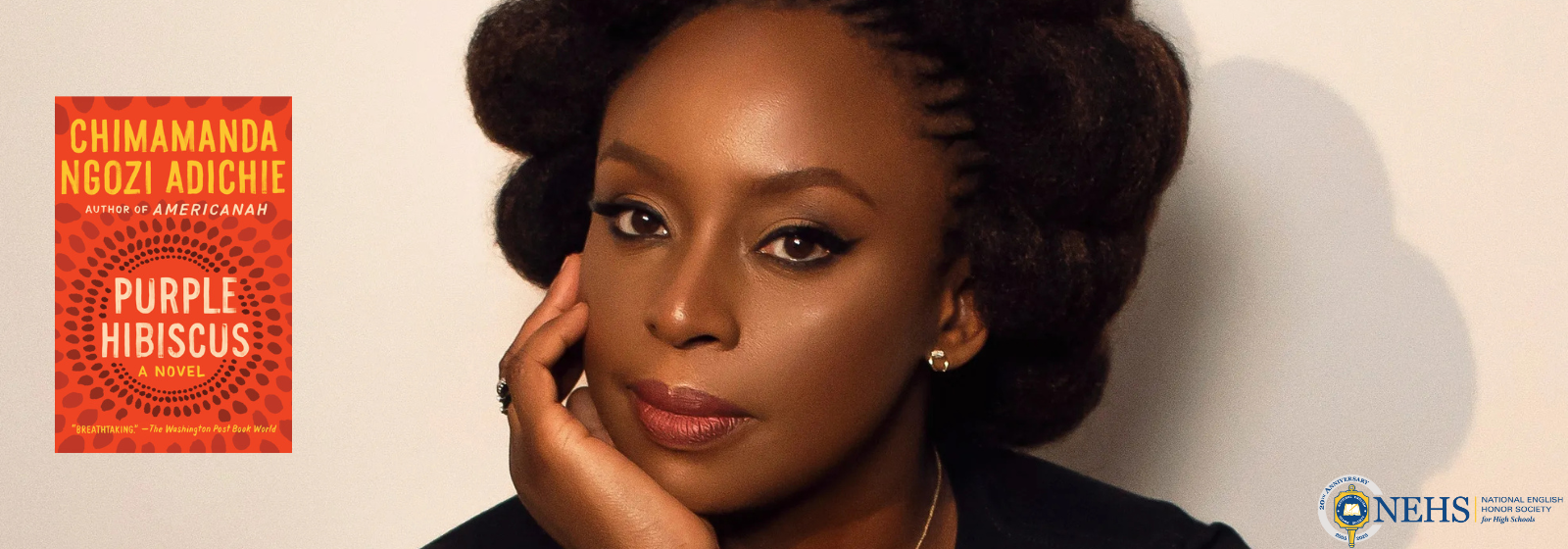
Born in September 1977, Chimamanda Ngozi Adichie has become one of the most powerful literary voices of our time, unafraid to confront culture, religion, and gender with unflinching honesty. Her writing challenges readers to see how societal norms can shape, confine, and sometimes harm individuals, especially through rigid gender expectations. In this blog, Jonathan Ahumuza, an NEHS senior at St. Andrews School in Turi, Kenya, reflects on how Adichie’s Purple Hibiscus shows the costs of these norms while also providing hope for transformation and freedom.
Adichie and the Fight Against Gender Norms
Chimamanda Ngozi Adichie’s novels address many of the tyrannical forces we all face in life: Adichie masterfully brings to light the domineering aspects of culture, religion, and society as well as emphasizing their effects on the individual.
She addressed one of these barriers during her TED Talk entitled “We should all be feminists,” and suggested that gender poses a problem in that it instructs individuals on how they should act rather than recognizing who they are. Personally, I took this to mean that one’s gender comes with expectations that dictate an individual’s behavior, limits their expressiveness, and impedes their interests. In this way, gender acts more as a restrictive label than simply a demographic. In Uganda, my home nation, a man can be deemed unbecoming by his relatives because he earns less than his wife. The desires of women, be it sexual or emotional, are neglected at the convenience of their husband’s. In Purple Hibiscus, Adichie explores many similar circumstances where a gendered hierarchy can destroy the family unit and stifle the individuality of children who live under such a system.
Adichie creates many characters who could be seen to embody the repressive nature of gender, especially in her first novel, Purple Hibiscus. Kambili Achike is one of these characters, representing the daughter chasing perfection in alignment with her Catholic, Nigerian father’s expectations: she speaks only when spoken to, is obedient without question, and never speaks ill of her father, despite his episodes of domestic violence. Adichie, in the same TED talk, posits that girls are taught to feel shame and believe in inherent female guilt. Through Kambili, Adichie demonstrates that such teachings make young women dependent on their male superiors. As a reader you can see how this creates a constant fear, which makes Kambili afraid to speak her mind, unable to explore, and limited in her outlook on life.
In her novel, Adichie reflects situations taking place in many family units that use a hierarchy based on gender. I have seen how such a home can diminish the ambition of a young woman whose desires are tossed aside in favor of their parents’ agendas and how easily insensitive young men are made when they are taught to be “hard.” Adichie uses her writing to expose the fault of traditional gendered beliefs and, as readers, we must recognize how they rob so many of their freedom to define their identity outside of their gender. We must also change these beliefs within ourselves in the hope others will have more choice in how they act and live.
One of my favorite features of Adichie’s writing is how she encompasses the pressures of life, including gender, in the behavior of a given character (using intersectionality) to explore the reality of the nuances within the decisions they take. One could posit that the character of Mama could have run away from her marriage much earlier, saving herself and her children from years of domestic abuse. However, this suggestion is limited in view because it highlights abuse as the only factor within her marriage. It does not consider her role as a mother, which, by cultural tradition, obligates her to serve her husband or depend financially on her husband to ensure her children a good future. I liked this nuance, especially in the case of Mama, because I can see that it was difficult for her to escape her bleak circumstances. It made me more conscious of how unfair it is that women trapped in abusive families are sometimes labelled by their relatives as inept wives or as incapable adults when their circumstances may be more complicated than they seem. As a result, Adichie propels the reader into thinking it’s important to take all perspectives and opinions, including your own, with a grain of salt before making judgment of anyone.
Prior to studying Purple Hibiscus in a classroom setting, I never thought to reflect on the pressures my older sisters felt. Rarely did I ask why they were expected to help prepare meals, clean the house, or tend to visitors while I was not. Upon analysis of Adichie’s narrative, I recognized that this (stereotypically African) parenting style was spawned by the cultural belief that women must continually validate their worth through obedience and hard work. Otherwise, especially in the more rural settings I experienced in Uganda, women are seen as failures by their parents and their communities.
If asked to sum up what I learned from Purple Hibiscus and Adichie’s journey, I would say it was the recognition that we must be willing to continuously change: our thinking, our way of life, our culture, our purpose. Sheepish teenage girl Kambili was able to speak her mind, laugh, and express her love by the end of the novel, simply because she was made aware that she is innately valuable and does not need to prove herself so. Similarly, a young man who was never expected to prepare meals before does so (having read the novel) with his sisters because he believes it is as much his duty as theirs. Among many other features, Adichie’s story reflects her belief that all human beings can make and remake themselves. I agree with Adichie’s belief, and I see her novel as a catalyst that enables readers to recognize the ideas, traditions, and mindsets that oppress individuals, propelling us to overcome them.
Jonathan Ahumuza is a senior at St. Andrews School, Turi in Kenya. Despite studying in Kenya, Jonathan is Ugandan. He has been a member of the Whispers of the River NEHS chapter at his school for two years and was Assistant Editor for his school magazine, The Turi Times. From time to time, he enjoys reading romance stories and watching cinematic action films. He regularly participates in sports like football (soccer) and field hockey. He relishes the study of chemistry and biology and leads a group of student tutors in his school to help other students academically in these subjects and various others. He hopes to continue serving through a career in healthcare as a medical doctor.
National English Honor Society
The National English Honor Society (NEHS), founded and sponsored by Sigma Tau Delta, is the only international organization exclusively for secondary students and faculty who, in the field of English, merit special note for past and current accomplishments. Individual secondary schools are invited to petition for a local chapter, through which individuals may be inducted into Society membership. Immediate benefits of affiliation include academic recognition, scholarship and award eligibility, and opportunities for networking with others who share enthusiasm for, and accomplishment in, the language arts.
America’s first honor society was founded in 1776, but high school students didn’t have access to such organizations for another 150 years. Since then, high school honor societies have been developed in leadership, drama, journalism, French, Spanish, mathematics, the sciences, and in various other fields, but not in English. In 2005, National English Honor Society launched and has been growing steadily since, becoming one of the largest academic societies for secondary schools.
As Joyce Carol Oates writes, “This is the time for which we have been waiting.” Or perhaps it was Shakespeare: “Now is the winter of our discontent made glorious summer . . .” we celebrate English studies through NEHS.
National English Honor Society accepts submissions to our blog, NEHS Museletter, from all membership categories (students, Advisors, and alumni). If you are interested in submitting a blog, please read the Suggested Guidelines on our website. Email any questions and all submissions to: submit@nehsmuseletter.us.
