

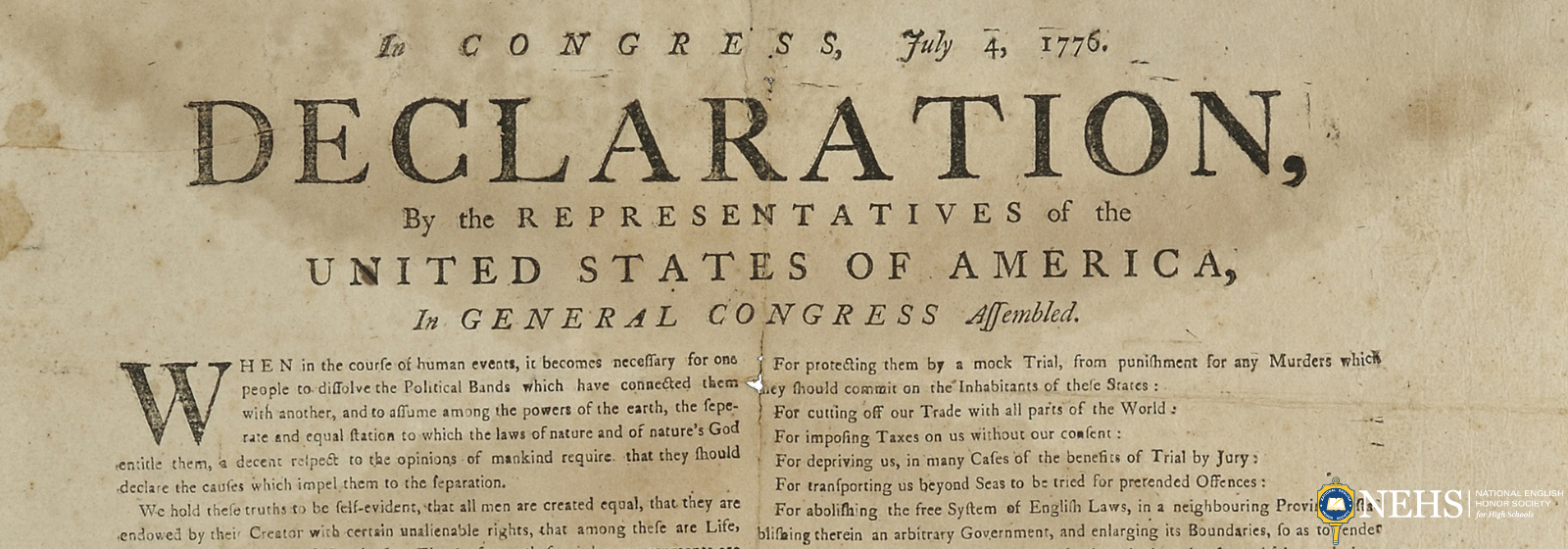
As the United States approaches the 250th anniversary of the Declaration of Independence, students from Upper Darby High School, PA, have examined the document from multiple perspectives, exploring its meaning, rhetoric, and legacy. In the texts below, Julia Philip considers the evolving interpretation of the phrase “all men are created equal,” Khandakar Mahin highlights the often-overlooked contributions of women’s Revolutionary-era correspondence, and Abigail Gangadeen analyzes the rhetorical strategies that have made the Declaration such a persuasive and enduring text.
The Meaning of: “All Men Are Created Equal”
“All men are created equal” is the idea Jefferson wrote of in the Declaration of Independence, but what did that statement truly mean? Were all men equal? From a modern point of view, many would say yes, but in 1776, the people who were truly considered equal were wealthy, white, landowning men, leading to the conclusion that the phrase wasn’t meant to apply to everyone. Instead, it was used to justify colonial independence from Britain, not as a statement of equality, reflecting the limited political ideals of the Founding Fathers; it was the generations that followed that transformed the phrase into the principle many know today as the pillar of universal equality.
Despite the power rooted in the phrase, “all men are created equal,” it was not intended to bring about social justice for disenfranchised communities impacted by the slave trade, but rather as a political argument for colonial independence from Britain. In the late 1770s, the United States of America was split into 13 colonies under British jurisdiction, but as resentment toward the British Monarchy grew following events like the Stamp Act, which sparked widespread protests over concerns about taxation without representation, the citizens of the 13 colonies revolted, and by August 2, 1776, the Declaration of Independence was published, including the famous phrase “all men are created equal.” The phrase, meant to challenge the very foundations upon which the British Monarchy was built, argued that no one was born with the right to rule over others; however, it meant little to the people of the United States, as slavery and other acts of inequality were still practiced. During this time, women were not given the right to vote, hold political office, or work in most professions. Enslaved African Americans were treated as property, often beaten, and forced to endure hours of grueling labor, while Indigenous people were displaced from their land despite being native to it, leaving only white, wealthy, landowning men with the liberty promised in the Declaration of Independence. However, these practices directly contradict the claim that “all men are created equal,” so what did the founding fathers truly mean by the phrase?
According to Stanford Historian Jack Rakove, the founders “did not intend to mean individual equality, ”but instead believed that “American colonists, as people, had the same rights to self-government as other nations.” The phrase served more as a political argument against Britain than as a statement of equality. In other words, the founders were not claiming that individuals were truly equal, but that the nation itself deserved to be equal to other countries. It was only later that Americans began to reinterpret the phrase, connecting it to equality. This can be seen in Frederick Douglass’ famous speech, “What to the Slave Is the Fourth of July?” (1852), in which he pointed out the hypocrisy of the phrase “all men are created equal” when there were millions of African Americans who were slaves. He argued that if the statement truly was meant to apply to everyone, then slavery violated the nation’s own principles about equality. Later, civil rights leaders, like Martin Luther King Jr., used the phrase to challenge segregation, racial injustice, and inequality.
Today, “all men are created equal” is understood to be the foundation upon which equality is built, and despite the intent the founding fathers had when they wrote it, one thing is clear: it has been used to help fight for the equality of millions, and so, its significance doesn’t lie in what it meant in 1776, but what it means now.

Julia Philip is a current junior at Upper Darby High School who is passionate about law, literature, and advocacy. Known for being hardworking, kind, and driven, she is committed to making a positive difference in the world, and through her various leadership experiences and strong dedication, this passion is shown in her work. As the founder of Star to Write, a youth-led organization, she has helped provide hundreds of individuals both a voice and a platform to share their writing, art, and photography. In addition to her work at Star to Write, she is the current vice president of Women Empowerment Society, where she advocates for women’s rights and the need for equality.
Secret Inks: The Hidden Revolutionary Letters of American Women
The American Revolution generated several kinds of writing the country has learned how to honor. There are the public declarations, the broadsides, the pamphlets that announced themselves as political. There is also a second body of writing, smaller in print run and quieter in tone, which has not been absorbed into the founding canon with anything like the same confidence. As the country approaches the 250th anniversary of the Declaration of Independence, the question of how to read this archive becomes harder to defer. The letters women wrote during the Revolutionary era are some of the most accomplished political prose of the period, and they are also, formally, an underread literary form.
Begin with Abigail Adams. Between 1761 and her death in 1818, she produced roughly twelve hundred surviving letters, more than a thousand of them to her husband John during his long absences in Philadelphia, Paris, and London. Her famous March 1776 letter, asking John to “Remember the Ladies” and warning that “all Men would be Tyrants if they could,” is often excerpted as a single quotable line. The letter itself is something else. It moves through household economy, troop movements, smallpox in Boston, the conduct of the Continental Congress, and the legal status of married women, all in a paragraph that does not separate the domestic from the political. The sentence about tyrants is not an interruption. It is the argument the letter has been building toward through its other subjects. Adams writes like a person who knows that the household is where the law will be felt.
Mercy Otis Warren worked across more visible forms, publishing satirical plays in the 1770s and, in 1805, a three-volume history of the Revolution, one of the earliest such histories written by anyone. But her correspondence with John Adams, Thomas Jefferson, Samuel Adams, and Catharine Macaulay is where the political argument gets tested before it reaches the press. Warren writes letters that represent the intellectual life she was not permitted to lead in public. Esther De Berdt Reed’s “Sentiments of an American Woman,” published in Philadelphia in 1780, takes that habit a step further. It is a broadside in the form of an address, the public extension of the kind of writing women had been doing privately for years, now arranged to fund Continental soldiers directly through women’s own organizing.
The familiar letter, in the eighteenth century, was a hybrid form. It carried news, household instruction, devotional reflection, and political analysis in the same paragraph, and it did so for a reader who would answer it. That structure made it the only literary genre available to women without a publisher’s permission. Read together, these letters are not a supplement to the founding documents. They are a parallel founding archive, written in the only register the period made available to half the population. The 250th anniversary is an occasion to read them as literature, which is to say, to read them whole.

Khandakar Mahin, a senior, serves as the President of The Royal Oak—Upper Darby High School’s chapter of the National English Honor Society. His passion for English literature has been evident since his early days in elementary school, where he began exploring creative fiction. He firmly believes that storytelling is one of the greatest creative outlets and recognizes the importance of media as a force of ideas. Khandakar’s favorite fiction author is Stephen King, although his favorite novel is George Orwell’s 1984. Khandakar is a 2025 NEHS Convention Presentation Winner, where he presented his literary analysis on Willa Cather’s One of Ours. In an age of AI, he believes that writing is one of the greatest outlets for critical thinking. This belief compels him to continue writing with passion. Khandakar is attending Harvard College this fall and hopes to use his studies in English for positive impact.
Rhetoric of the Declaration
According to philosopher John Locke, every person possesses natural rights that are not given by governments but instead are inherent to human existence. In Two Treatises of Government (1689), Locke developed the ideas of natural rights and the social contract, directly challenging the divine right of kings and the legitimacy of absolute monarchy. His Enlightenment philosophy influenced a period of growing political questioning throughout the British Thirteen Colonies during the late 17th and 18th centuries, encouraging individuals to challenge traditional authority and value individual liberty.
When Thomas Jefferson began drafting the Declaration of Independence in Philadelphia in June 1776, he heavily incorporated Locke’s Enlightenment ideas into the document. Jefferson’s famous phrase, “life, liberty, and the pursuit of happiness,” was inspired by Locke’s original wording, “life, liberty, and property.” By altering the phrase, Jefferson emphasized the colonists’ desire for freedom and the ability to pursue their own futures without British control. Furthermore, Jefferson structured the Declaration as a formal, logical argument shaped by Enlightenment ideals of reason and justice. He first introduced broad principles about government and human rights, including the famous statement, “All men are created equal.” which reflects the Enlightenment belief that all people are born with natural rights and basic equality. He also referred to “certain unalienable Rights,” arguing that freedoms such as liberty cannot be taken away by any government.
After establishing these principles, Jefferson presented a lengthy list of grievances against King George III to emphasize the need for independence. Through the repeated use of the phrase “He has,” Jefferson emphasized the king’s repeated abuses of power and created a powerful rhythm throughout the document. Jefferson cleverly placed the grievances after the discussion of natural rights, making the king appear to be repeatedly violating the very principles that governments are supposed to protect.
The structure of the Declaration strongly influenced colonists because it first reminded them of what a fair government should do before explaining how Britain failed them. As the grievances became more serious and repetitive, readers felt a growing sense of frustration and urgency. This structure transformed anger into motivation by convincing colonists that independence was necessary for liberty and justice, rather than a reckless rebellion. Jefferson’s combination of political ideals, evidence against the king, and references to shared colonial experiences made independence appear reasonable and justified.
Although the Declaration was written during the Revolutionary era, its language continues to inspire movements for equality today. Jefferson used broad and universal language about human rights and freedom that could apply beyond the American colonies. For example, when he wrote, “Whenever any Form of Government becomes destructive of these ends, it is the Right of the People to alter or abolish it,” he argued that people always have the right to challenge unjust governments, regardless of the period.
Because the Declaration of Independence argues that rights belong naturally to all people, many later groups connect their own struggles for equality to its message. Its ideals extend beyond the American Revolution and continue to represent liberty, justice, equality, and the belief that all people deserve representation and basic human rights.

Abigail Gangadeen is a senior at Upper Darby High School who has been actively involved in numerous clubs and activities, including band, choir, orchestra, honor societies, and student council. She has been a member of Upper Darby’s chapter of the National English Honor Society since the end of her freshman year and has served as Treasurer throughout both her junior and senior years. Her favorite aspect of NEHS has been participating in volunteer work and attending college symposium opportunities. Outside of school, Abigail enjoys spending time with friends and family, serving on her church’s worship team, and working as a pharmacy technician. In the fall, she will begin college while pursuing a career as a physician assistant.
National English Honor Society
The National English Honor Society (NEHS), founded and sponsored by Sigma Tau Delta, is the only international organization exclusively for secondary students and faculty who, in the field of English, merit special note for past and current accomplishments. Individual secondary schools are invited to petition for a local chapter, through which individuals may be inducted into Society membership. Immediate benefits of affiliation include academic recognition, scholarship and award eligibility, and opportunities for networking with others who share enthusiasm for, and accomplishment in, the language arts.
America’s first honor society was founded in 1776, but high school students didn’t have access to such organizations for another 150 years. Since then, high school honor societies have been developed in leadership, drama, journalism, French, Spanish, mathematics, the sciences, and in various other fields, but not in English. In 2005, National English Honor Society launched and has been growing steadily since, becoming one of the largest academic societies for secondary schools.
As Joyce Carol Oates writes, “This is the time for which we have been waiting.” Or perhaps it was Shakespeare: “Now is the winter of our discontent made glorious summer . . .” we celebrate English studies through NEHS.
National English Honor Society accepts submissions to our blog, NEHS Museletter, from all membership categories (students, Advisors, and alumni). If you are interested in submitting a blog, please read the Suggested Guidelines on our website. Email any questions and all submissions to: submit@nehsmuseletter.us.
