
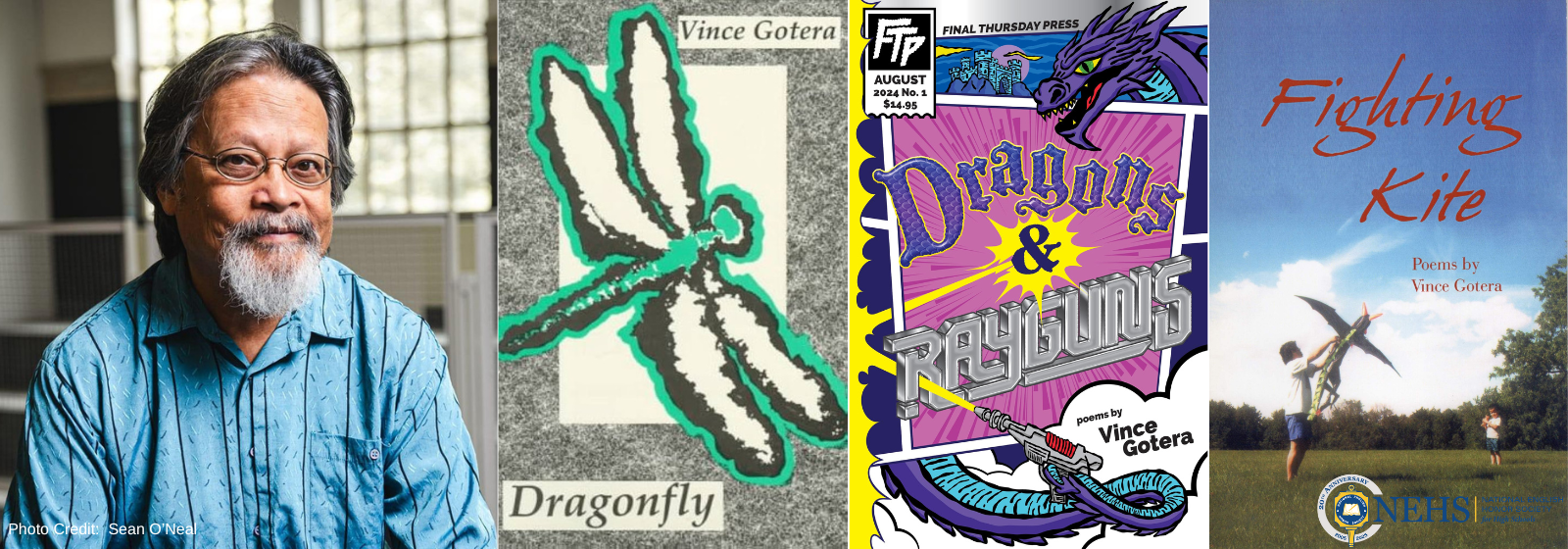
In celebration of Asian American, Native Hawaiian, and Pacific Islander (AANHPI) Heritage Month, students at Tripoli High School had the honor of sitting down with Iowa’s current Poet Laureate, Vince Gotera, for a conversation about poetry, heritage, and representation. As the first Poet Laureate of Asian descent in Iowa, Gotera brings a vital and vibrant voice to the state’s literary landscape. His work spans decades and genres, and his passion for elevating diverse perspectives through poetry is unshakeable. Read on to find out more about Gotera and AANHPI Heritage Month.
Honoring AANHPI Voices: An Interview with Iowa’s Poet Laureate
May is Asian American, Native Hawaiian, and Pacific Islander (AANHPI) Heritage Month, celebrated annually in the US to honor the histories, cultures, and contributions of people with ancestry from the Asian continent and Pacific Islands. Throughout May, events and activities in communities across the country highlight the achievements, strength, and contributions of AANHPI people to American society.
As our way of recognizing AANHPI in the world of English Language and Literature, we are featuring an interview with Vince Gotera, the current Poet Laureate of the state of Iowa and the state’s first Poet Laureate of Asian/Pacific Islander descent. Gotera is a professor emeritus of English from the University of Northern Iowa and former editor of the North American Review. To date, he has authored five poetry collections: Dragonfly, Ghost Wars, Fighting Kite, The Coolest Month, and Dragons & Rayguns.
Vince, how did you come into poetry as a writer and as a teacher?
I wrote my first poem at age six, and it got published in my school’s newsletter. I wrote poems a bit later as well, especially in high school, and then studied poetry writing in college and graduate school. I earned a Master of Fine Arts in Poetry Writing at Indiana University. From that point, I taught creative writing—not just poetry but also the writing of fiction and creative nonfiction—at Humboldt State University and then later at the University of Northern Iowa, where I taught for almost thirty years. I also previously taught creative writing at Indiana University, when I was in graduate school, as an associate instructor. All in all, I’ve been writing poetry seriously for at least fifty years, probably longer, and teaching poetry for some forty years.
How much would you say your Filipino heritage and/or experiences as a Filipino-American inspire or fuel your writing?
I write quite a lot on Philippine and Philippine American topics. For example, I have just finished a novel-in-poems on mythical Philippine monsters, called aswang: two lovers, a vampire and a shapeshifter, surviving in plain sight, pretending to be ordinary humans. I’m currently seeking a publisher for that book. Apropos of that, I’ve been writing speculative poetry in recent years: science fiction, fantasy, and horror poetry. Those are the genres covered in my recent book, Dragons & Rayguns, and there are several Filipino-oriented poems in that book. I also have written about daily life and culture connected to the Philippines and the Filipinx diaspora.
You are the first Poet Laureate of the state of Iowa who is of Asian descent. Do you feel that is of particular significance for our state?
Yes, that’s correct. I’m also the first Iowa Poet Laureate who is a person of color. I think it’s important for people in our state to be introduced to a variety of experiences and cultural viewpoints. My Filipino heritage specifically, Asian ancestry more largely, and my life experiences as a person of color in the US, all help to expand that exposure.
What kind of responsibilities and experiences does the role of Iowa’s Poet Laureate consist of?
My job as Poet Laureate of Iowa is to elevate poetry as an art form and common occurrence, hopefully, for Iowans and within Iowan life. I give poetry readings, workshops, and presentations at libraries, schools, colleges, churches, and civic groups, among others. I also often give interviews, like to TV stations, for example, to talk about poetry and how it can enhance our daily lives. I hope eventually to visit all corners of the state talking about the beauty of poetry and the elements of poetry writing.
Will you be doing anything special to celebrate AANHPI month?
I have the honor of giving a poetry reading for the Coralville Public Library at the Coralville Asian Fest on May 17.

Isabel Bernard is a member of the graduating class of 2025 from Tripoli High School in Tripoli, IA. She has served as the President of the Literati Chapter of NEHS in 2024 – 2025 during which time she led multiple chapter projects to serve the school and community. In her final year of high school, Isabel has developed an interest in the literary genre of dark academia. Her favorite memories as a member of NEHS are helping with community service events with other Literati Chapter members. In fall 2025, Isabel plans to attend the University of Iowa to study Nursing and Spanish and one day, hopefully, apply her skills abroad.

McClain Franzen is a member of Tripoli’s graduating class of 2025 and has served as the Vice President of the Literati Chapter in 2024 – 2025. One of the accomplishments he is most proud of as a member of NEHS is assisting the chapter in earning the David Wendelin Classroom Library Grant. Outside of school, McClain has developed a deep passion for volleyball, playing on multiple club teams for the past twelve years. His favorite memories in NEHS consist of spending time with the chapter for fundraising events and attending Shakespeare’s The Tempest with chapter members. In August, he will be attending the University of Northern Iowa to study Nursing and Spanish. He will also serve as the UNI women’s volleyball team manager.
National English Honor Society
The National English Honor Society (NEHS), founded and sponsored by Sigma Tau Delta, is the only international organization exclusively for secondary students and faculty who, in the field of English, merit special note for past and current accomplishments. Individual secondary schools are invited to petition for a local chapter, through which individuals may be inducted into Society membership. Immediate benefits of affiliation include academic recognition, scholarship and award eligibility, and opportunities for networking with others who share enthusiasm for, and accomplishment in, the language arts.
America’s first honor society was founded in 1776, but high school students didn’t have access to such organizations for another 150 years. Since then, high school honor societies have been developed in leadership, drama, journalism, French, Spanish, mathematics, the sciences, and in various other fields, but not in English. In 2005, National English Honor Society launched and has been growing steadily since, becoming one of the largest academic societies for secondary schools.
As Joyce Carol Oates writes, “This is the time for which we have been waiting.” Or perhaps it was Shakespeare: “Now is the winter of our discontent made glorious summer . . .” we celebrate English studies through NEHS.
National English Honor Society accepts submissions to our blog, NEHS Museletter, from all membership categories (students, Advisors, and alumni). If you are interested in submitting a blog, please read the Suggested Guidelines on our website. Email any questions and all submissions to: submit@nehsmuseletter.us.
