
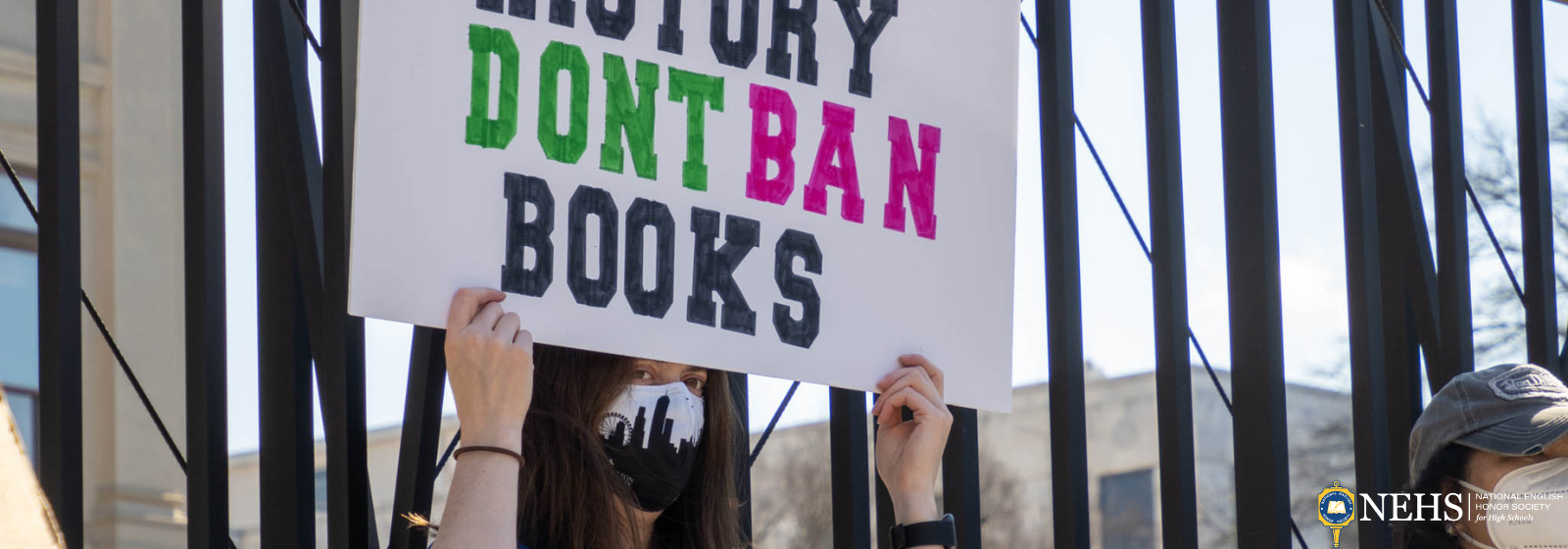
In recognition of Banned Books Week 2026, Karyna Volovyk and Logan Sprock, eleventh-grade students at Grandview High School, CO, explore the impact of book banning and censorship in the United States by drawing on works such as Fahrenheit 451, The Diary of a Young Girl, and All Boys Aren’t Blue.
Learn more about Banned Books Week 2026.
Banned Books: Protection or Suppression?
You wake up. It’s a day like every other, where you do your normal routine, have breakfast, and leave the house for work. You’re walking down the street and see a man setting books aflame. You smile at him, wave, ask how his day is, and continue your walk to work. Nothing out of the ordinary is happening.
This scenario comes from Fahrenheit 451, a book about a dystopian society where people destroy literature and question nothing. Everyone is used to it, but in reality, it takes generations deprived of education to reach such a point; it might start as small restrictions made for “our own good.” Today, many books are being banned, restricted, or reviewed by states, districts, or the government in the United States and many believe it is done to protect children from “inappropriate” and “sensitive” topics. Withholding knowledge, however, isn’t the way to improve and teach. Books allow you to gain experiences you wouldn’t otherwise have.
The books that cover sensitive topics are the important ones. They allow us to recognize current human rights violations, and prevent history from repeating itself. As Fahrenheit 451 has shown us, recorded experiences are a threat to tyranny: books are burned to ensure “happiness” or to simply prevent curiosity. The Diary of a Young Girl is a great example of a difficult, tragic story that gives us access to a perspective of a person who lived through tyranny and helps us recognize mistreatment today. The Diary of a Young Girl is a diary of a Jewish girl, Anne Frank, who lived during the Holocaust and was forced to hide in an attic with her family. Anne Frank was eventually found. She died at a concentration camp, from disease and weakness, in 1945. It was believed that those were camps for “criminals” and that people were sent where they “belonged.” It was horrific and inhumane. Today, many people in detention centers and prisons face similar treatment. Staying educated on this topic and reading about the experiences of those who lived through it helps us recognize such mistreatment and prevent it happening again. History can repeat itself and we need to remain aware of what has happened in the past.
Books have always been tools to learn, whether that’s about history, others, or oneself. All Boys Aren’t Blue is a book about growing up queer, black, and the difficulties of that journey, including experiencing assault. This book represents many minority groups, and can be used to teach and help those who may encounter the same struggles. Many states and school districts have been banning books that contain LGBTQIA+, race, and/or gender themes, labeling them “inappropriate” or “sexually explicit.” The truth is this, those are vague excuses used to eradicate diversity and create a stigma around being “different.” Banning books like these can limit resources for these groups and lead the people within them to feel ostracized from society. Around 1/3 of banned or restricted books focus on DEI, identity, and equity. Political and conservative groups have been able to influence government-funded sources (e.g. libraries and schools) to restrict access to books they do not agree with. Indeed, many laws have been introduced or altered to allow books to be reviewed or pulled more easily from schools, libraries, and other accessible community sources.
Book banning and restriction is detrimental and takes away an opportunity to learn something new, understand the world, and ourselves. It is important that we ensure that scenes of burned books remain a story rather than our reality.

Karyna Volovyk is an eleventh-grade student at Grandview High School and a member of the National English Honor Society. She is actively involved in her community, serving multiple officer roles in a variety of clubs, as well as tutoring kids from underprivileged backgrounds and teaching English to women from Afghanistan. Karyna is a very creative person and enjoys writing and music—she writes poems and plays the violin. Karyna has a deep passion for learning and experiencing new things, whether it’s at school, trying a new experience with friends, or learning something new at work. She believes that supporting others is what it takes to be happy and make the community thrive, and she wants to go into pediatrics to support children and their families.
Logan Sprock is an eleventh-grade student at Grandview High School and a member of National English Honor Society. He is involved in many clubs and societies at Grandview and holds multiple officer roles. He’s also a part of the performing arts in band and theatre, playing flute and doing audio, as well as art, doing ceramics. Outside of school, Logan volunteers in his community at clothing and school supply drives. Logan has always had a love for understanding how things work: the systems that make things work. He plans to enter the medical field in the future.
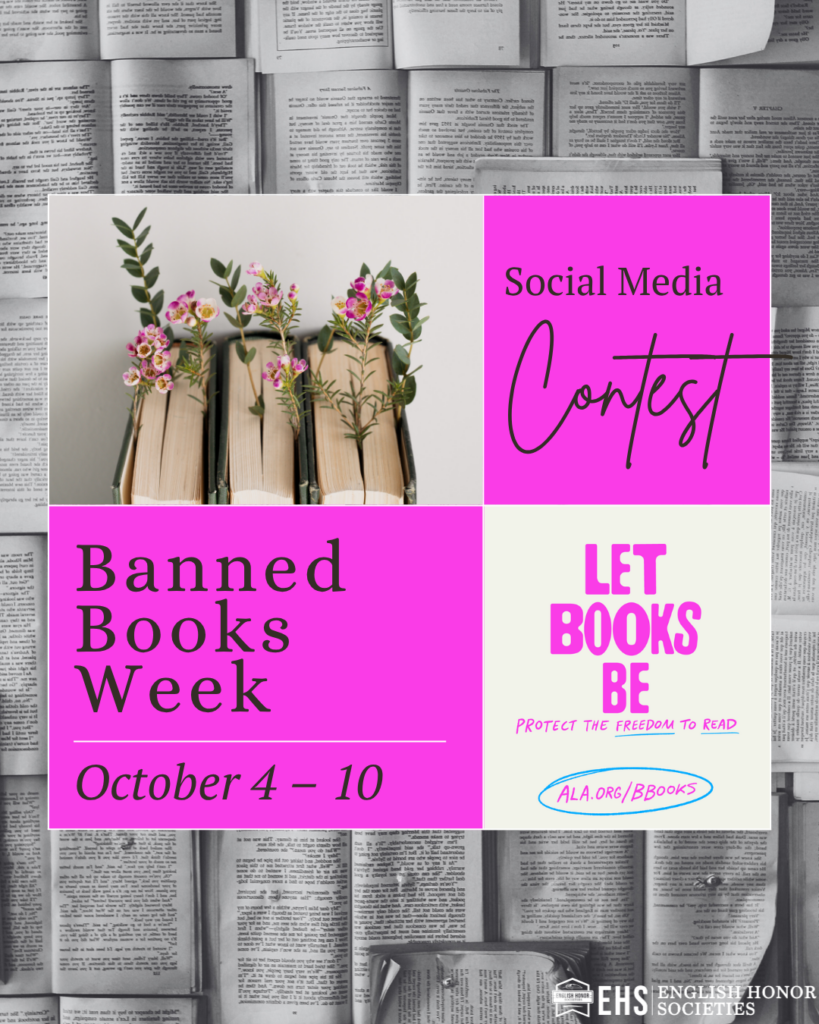
2026 Banned Books Week Social Media Competition
In celebration of Banned Books Week (October 4 – 10, 2026), NEHS, Sigma Tau Delta, and the ELA Honor Society are teaming up to host the tenth annual Banned Books Week social media contest for student members and Chapter Advisors. To participate you must tag us in a post on any of the following social media accounts:
- NEHS Facebook
- NEHS Twitter (@NEHSXPress)
- English Honor Societies Instagram (@EnglishMatters)
What to do in Your Post:
Books are banned for a variety of reasons. Take your own original photo of your favorite banned book and share with us (on one social media platform) one of the reasons it has been contested. If you wish to post on a second platform, please choose a second banned book to post about.
The contest will run October 4 – 10, 2026. Everyone who participates during this time frame will be entered in a drawing to win one of three $25 Bookshop.org gift cards. A $50 Bookshop.org gift card will also be awarded for the best overall post. Select submissions will be shared across our social media platforms.
National English Honor Society
The National English Honor Society (NEHS), founded and sponsored by Sigma Tau Delta, is the only international organization exclusively for secondary students and faculty who, in the field of English, merit special note for past and current accomplishments. Individual secondary schools are invited to petition for a local chapter, through which individuals may be inducted into Society membership. Immediate benefits of affiliation include academic recognition, scholarship and award eligibility, and opportunities for networking with others who share enthusiasm for, and accomplishment in, the language arts.
America’s first honor society was founded in 1776, but high school students didn’t have access to such organizations for another 150 years. Since then, high school honor societies have been developed in leadership, drama, journalism, French, Spanish, mathematics, the sciences, and in various other fields, but not in English. In 2005, National English Honor Society launched and has been growing steadily since, becoming one of the largest academic societies for secondary schools.
As Joyce Carol Oates writes, “This is the time for which we have been waiting.” Or perhaps it was Shakespeare: “Now is the winter of our discontent made glorious summer . . .” we celebrate English studies through NEHS.
National English Honor Society accepts submissions to our blog, NEHS Museletter, from all membership categories (students, Advisors, and alumni). If you are interested in submitting a blog, please read the Suggested Guidelines on our website. Email any questions and all submissions to: submit@nehsmuseletter.us.
