

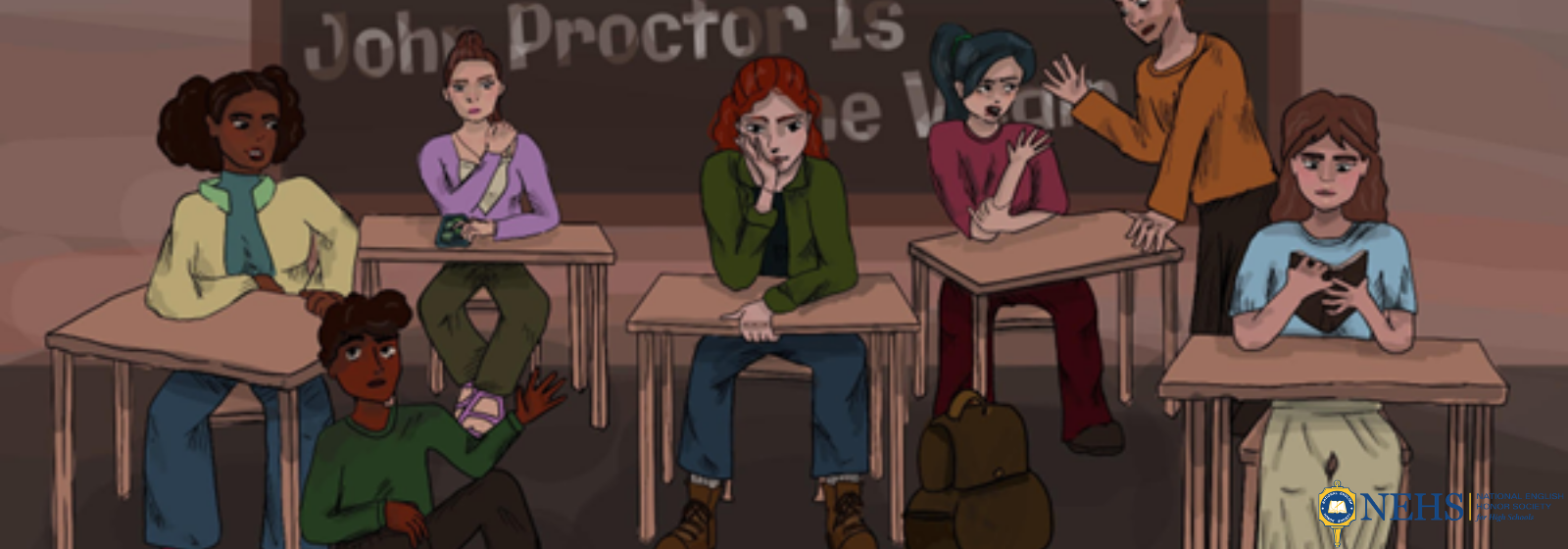
Art by Vivienne Lee, freshman at Clarksburg High School
In celebration of Women’s History Month, students from Clarksburg High School, MD, share a collection of reflections that examine the representation, complexity, and creative power of women in theatre and literature. From Wicked to Fun Home, John Proctor Is the Villain, and Hadestown, these pieces highlight the importance of women’s voices both on and off the stage. They explore how storytelling can challenge stereotypes, amplify underrepresented perspectives, and reshape the narratives we value. This reminds us that when women lead, create, and speak, the stories we tell become richer, more honest, and more transformative.
Reclaiming the Narrative: Feminism, Power, and Perspective in John Proctor Is the Villain
“Maybe, one day, the new world we were promised will actually be new. One day, maybe the men in charge won’t be in charge anymore,” proclaims Raelynn, a central character in one of the decade’s most relevant—and needed—plays. In Kimberly Belflower’s 2022 contemporary play, John Proctor Is the Villain, students from a rural Georgia high school examine Arthur Miller’s classic play The Crucible and utilize their school’s newfound feminist club to draw parallels between the deep misogyny of the Salem witch trials and their own experiences growing up as young women in the aftermath of the #MeToo movement. At the crux of John Proctor Is the Villain, the main character, Shelby, proclaims that The Crucible‘s protagonist, John Proctor, was indeed the villain of the story because of his abusive power in pursuing a sexual affair with teenager Abigail Williams.
As a female high school student myself, I have often been faced with situations where I notice my male counterparts are unfairly praised and elevated in the public eye at higher frequencies than me and my fellow female students are. It’s a constant struggle, and as a driven student, I always feel as if I must put on a metaphorical performance, like the girls in The Crucible, to even be noticed. I have known countless “John Proctors”: men who are unjustly praised despite their shortcomings, and who use “Abigails” for personal gain. John Proctor Is the Villain is a modern masterpiece in acknowledging this overlooked issue.
Kimberly Belflower encompasses the teenage girl experience, the prevalence of the patriarchy in daily interactions, and how often it has prevented girls from excelling. In a world where male playwrights dominate the field, oftentimes women do not feel that their voices and day-to-day experiences are authentically reflected onstage. According to the American Theatre Magazine, only 33% of plays grossing more than $10 million at US theaters in the 2025-2026 season were written by cis women (not including trans women or nonbinary playwrights, whose plays accounted for less than 8%). Not only is this an issue in the professional world, but I have also noticed it on my school stages. Out of the eleven full-length theater productions I have been in since middle school, only three have been written or co-authored by women. I bring this up to acknowledge the representation gap in plays and musicals that are produced in our own communities alongside professional spaces. To combat this disproportionate number, directors, production teams, and casual theatergoers must make an active effort to seek out and support gender diversity in theater.
As someone who hopes to continue my academic career surrounded by the arts, I look forward to seeing a marked change in playwriting representation in these upcoming years. Being a part of NEHS has encouraged me to seek out literature that contains multitudes of different perspectives that aren’t always featured in the spotlight. With this, I hope to have the opportunity to read and perform more plays that tactfully address and honor feminine-specific experiences in an authentic and non-stigmatized manner.
Savin Criddle is currently a sophomore at Clarksburg High School in Clarksburg, MD. Throughout her life, she has enjoyed storytelling in all forms, strengthening her immense love for literature and theater. When she’s not reading or on stage, she loves to make music by singing, playing the flute or the piano, learning new languages (much to the relief of her Duolingo streak), and making a crafty mess on her desk. This is her first year in the National English Honor Society.
Beyond the Bechdel Test: Amplifying Women’s Voices in Fun Home
Theatre is a space where human stories are told. Although this is the case, it is notably obvious that many well-known plays struggle to meet the simplest standards of female representation. The Bechdel Test, originally established to assess women’s presence in films, is a criterion that many films, even today, fail to meet. This test asks the question of whether a work of media features at least two women who can speak to one another about something other than a man. Although the Bechdel Test is not intended to determine the overall excellence of a piece, it shows how women’s voices can often be neglected and viewed as secondary to a man. It highlights the fact that women are often portrayed (especially in film and theatre) as “unimportant,” sidelined, and given less attention unless a man is brought into the picture.
I have become increasingly aware of how women’s voices are minimized. It is hard to let this go unnoticed, especially as a female high school student. Whenever I find myself in a group setting, it’s hard to ignore that my male peers are praised more openly, whilst my female peers are usually overlooked and asked to be supportive rather than outspoken. These same patterns are found in many narratives, where female characters only exist to be a love interest or moral support instead of being their own person with developed personality traits. Thus, being able to see women speaking honestly and vulnerably with one another in the theatre feels not only refreshing, but also necessary.
Jeanine Tesori’s and Lisa Kron’s musical Fun Home was adapted from Alison Bechdel‘s deeply personal graphic memoir. This musical easily passes the Bechdel Test, but, more importantly, it goes beyond it. The women in Fun Home typically converse about themes of family, sexuality, and identity. These topics can exist without the concern of male validation or meddling of any sort. Throughout the musical, Alison interacts with different versions of her younger self and with her mother, Helen. Instead of seeing the typical storyline unfold, the audience sees emotional and complex relationships between women. Its female characters were not written to be likable, submissive, and comedic to please the audience. Instead, they are allowed to be flawed and unconventional in some ways.
This rawness and authenticity are often missing from many plays. Hence, it is important to have more women showcase the experiences through which they have lived. When female writers can tell their own stories, not only does it result in better representation, but also a more honest and true depiction of what it feels like to be a woman. This is an idea that I’ve become increasingly aware of as an English scholar and as a member of NEHS. This has helped me realize how important it is to recognize the voices that have been overlooked for decades in history. Applying the Bechdel Test to theatrical works like Fun Home, shows how crucial women’s voices are in stories that reflect real experiences. Elevating female playwrights to the same level as male playwrights is, in fact, necessary. This balance ensures that stories told on stage reflect experience that exists beyond just one singular perspective.

Aarna Ghorpade is a sophomore at Clarksburg High School in Clarksburg, MD. She has always been passionate about literature, as she has developed a love for both reading and writing. Whether she is deeply immersed in a novel or working on writing stories of her own, she is always open to exploring new perspectives through words. This is her first-year being part of the National English Honor Society.
Defying Expectations: Rewriting Female Friendship in Wicked
Like most Broadway to film adaptations, Wicked originally began as a book. Originally published in 1995 by Gregory Maguire as a spin-off to L. Frank Baum’s 1900 book, The Wonderful Wizard of Oz, Maguire reimagines Baum’s story from a feminine perspective, featuring the Wicked Witch of the West, also known as Elphaba Thropp, and Glinda the Good Witch. Elphaba is a misunderstood Animal activist who stands out in particular because of her green skin, and Glinda is the well-liked, popular girl. Despite being portrayed as opposites, they disregard what is typical and begin a bond of friendship.
Elphaba’s and Glinda’s relationship starts as a rivalry, highlighting their jealousy of each other. Rather than challenging the frenemy trope, Maguire chooses to emphasize the unconditional support and growth the witches begin to display. They defy the common stereotype of competition within female friendships and, amidst the conflict that occurs within the narrative, they choose to instead focus on mutual support.
Debuting in 2003, Wicked provided a powerful narrative in theatre, where women are the protagonists of their own stories rather than being supporting characters within a male-driven plot. Wicked empowers female views, showing how female characters are allowed to be complex in theatre: demonstrating that it is possible for a female character to be flawed, yet still be powerful. Re-inventing the concept of “wickedness,” challenging the idea that women can only be “good” or “evil,” provides a realistic portrayal of how female friendship looks to many. The musical ends with a duet from the witches, where they acknowledge their profound impact on each other’s lives, signifying the prevalent theme of friendship, sacrifice, and unconditional love, before parting ways forever.
I found the story of Wicked to positively contribute to the need for more female friendships in the media. As a female consumer of media, it is hard to ignore the consistent lack of acknowledgement of female friendships within TV shows, movies, and even literature. Maguire instead chooses to highlight the messy, complicated, yet transformative friendship between Elphaba and Glinda showing that female friendships in media don’t have to be bleak and one-dimensional and portrays them with impactful depth. Doing this serves as a positive representation of a realistic female friendship and changes the way female relationships are viewed within media, for the better.
Axelle Njomo is a sophomore at Clarksburg High school in Clarksburg, MD. With a consistent love for all things literature and writing since elementary school, she enjoys journaling and trying to complete her monthly reading goals. When not reading, she is writing a case for her high school’s debate team or using up all the cinnamon in her family’s kitchen for baking. This is her first year as a member of the National English Honor Society.
Divorced, beheaded, died, divorced, beheaded, survived!
You may have heard of the smash-hit musical known as Six. The unique show recounts the lives of the six wives of Henry VIII through a pop concert. Six rose in popularity after its debut at the Edinburgh Festival Fringe in August 2017. Today, Six is a worldwide hit that has appeared on Broadway and in West End theaters and international tours. The musical has won 26 awards, ranging from the 2022 Tony Award for Best Original Score to the Outer Critics Circle Award for Best Musical. Overall, Six has been widely praised for its entertaining nature.
Six has impressed millions of audiences worldwide. The show is jam-packed with catchy pop music, decorated choreography, and a live band performing with the wives on stage. But the flashy lights and blasting tunes tend to distract the audience from what the story is about: real women who fell victim to Henry VIII. By doing so, audience members are likely to replace the history of these wives with trivial song lyrics.
The main inaccuracy of the show lies in the characterization of Anne Boleyn. During her song “Don’t Lose Ur Head,” she floats around the stage acting like a ditzy teenager using expressions like “totes” and “XO.” In reality, Anne Boleyn was an educated, strong-willed woman who spoke her mind. Instead of the musical highlighting her headstrong personality, it turns her into a bubbly party girl.
History is important. It tells the stories of those who came before us. Six is a globally popular musical. And as a result, when people think of Henry VIII’s six wives, young people may only think of the glamorized musical that replaced their authentic story. In today’s age, stories like theirs are being retold in a fun, digestible way for everyone to understand. Historic-based theater shows have risen in popularity following the release of Hamilton and Les Misérables, but by supporting this form of media, we, as a society, risk forgetting the truth. To clarify, I love Six, the Musical. The songs and the ensemble cast are impeccable. I simply want to draw attention to the discrepancies in the musical’s writing and the morality of enjoying a show like this. By writing off real people’s stories as mere rhymes, we begin to forget the real events. So, as you dance to some of the Six classics, try not to forget the true stories of women behind those lyrics.
Arewa Alade is a senior at Clarksburg High School. She is an actress in her school theater production and the Secretary of the National English Honor Society at her school. She enjoys playing video games and singing tunes in her free time. After graduating, she wishes to pursue both sign language interpreting and practicing as a legal attorney.
Behind the Myth: Women’s Creative Power in Hadestown
Hadestown, the 2019 Broadway musical about the Greek myth of Orpheus and Eurydice with a contemporary industrial interpretation, has reached near-mythic status itself. With a large fan-base and critical approval, including the 2019 Tony Award for Best Musical, the show is beloved for its incredible cast members. Yet many fans overlook a crucial truth: Hadestown began with one woman’s vision and was brought to life by a powerful team of women behind the scenes.
According to Anaïs Mitchell’s interview with Broadway Direct, Hadestown started as a DIY theatre project. She wrote all the music, lines, and lyrics by herself, and recruited her musician friends to assist her with putting on small shows. Mitchell admits that they had “very little time or money to prepare for the productions, but everyone kind of came at it with their whole passion,” with the composer playing the leading role of Eurydice herself as they performed in a few theatres. After two years of those initial productions, Hadestown shifted into purely a studio album, before Mitchell set her sights on Off-Broadway.
That’s when she met Rachel Chavkin, the director of Natasha, Pierre, & the Great Comet of 1812. Mitchell was deeply inspired by how Chavkin maintained her folk and downtown music roots while understanding how to adapt the show to fit Broadway. In an interview with the Hanover Theatre & Conservatory, Mitchell emphasizes the strength of working with so many women behind the scenes for Hadestown: “You know, I had no idea [Chavkin] was a woman when I fell in love with her work. I don’t think it was our intention to build a female-led team, but we sought out the folks whose work we responded to most, and many of them were women,” Mitchell reflects. “I felt my instincts were . . . trusted in a deep way.”
Mitchell was drawn to Chavkin’s work, which inherently reflected a woman’s perspective. Indeed, the strength of relatability and trust behind Hadestown is what draws people now to the musical, even if they do not consciously realize it. Hadestown has been a space for a female-led team to thrive, which ripples through the intimacy and unique vulnerability that the audience feels watching the musical. Theatre remains heavily male-dominated, especially when it comes to who is telling the stories. I have felt it in the shows I have watched and performed and have noticed how theatre students praise Sondheim and Schwartz but struggle to name female composers and writers. The show’s success demonstrates how powerful it can be when women are not only present, but leading and crafting the stories.
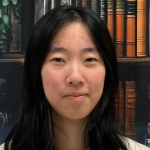
Abigail Cho, a senior at Clarksburg High School in Clarksburg, MD, serves both as a part of her school theatre program and as the Outreach/Event Coordinator for the National English Honor Society. She enjoys watching Broadway musicals and visiting art museums and plans to attend a 4-year university as an English major.
National English Honor Society
The National English Honor Society (NEHS), founded and sponsored by Sigma Tau Delta, is the only international organization exclusively for secondary students and faculty who, in the field of English, merit special note for past and current accomplishments. Individual secondary schools are invited to petition for a local chapter, through which individuals may be inducted into Society membership. Immediate benefits of affiliation include academic recognition, scholarship and award eligibility, and opportunities for networking with others who share enthusiasm for, and accomplishment in, the language arts.
America’s first honor society was founded in 1776, but high school students didn’t have access to such organizations for another 150 years. Since then, high school honor societies have been developed in leadership, drama, journalism, French, Spanish, mathematics, the sciences, and in various other fields, but not in English. In 2005, National English Honor Society launched and has been growing steadily since, becoming one of the largest academic societies for secondary schools.
As Joyce Carol Oates writes, “This is the time for which we have been waiting.” Or perhaps it was Shakespeare: “Now is the winter of our discontent made glorious summer . . .” we celebrate English studies through NEHS.
National English Honor Society accepts submissions to our blog, NEHS Museletter, from all membership categories (students, Advisors, and alumni). If you are interested in submitting a blog, please read the Suggested Guidelines on our website. Email any questions and all submissions to: submit@nehsmuseletter.us.
