

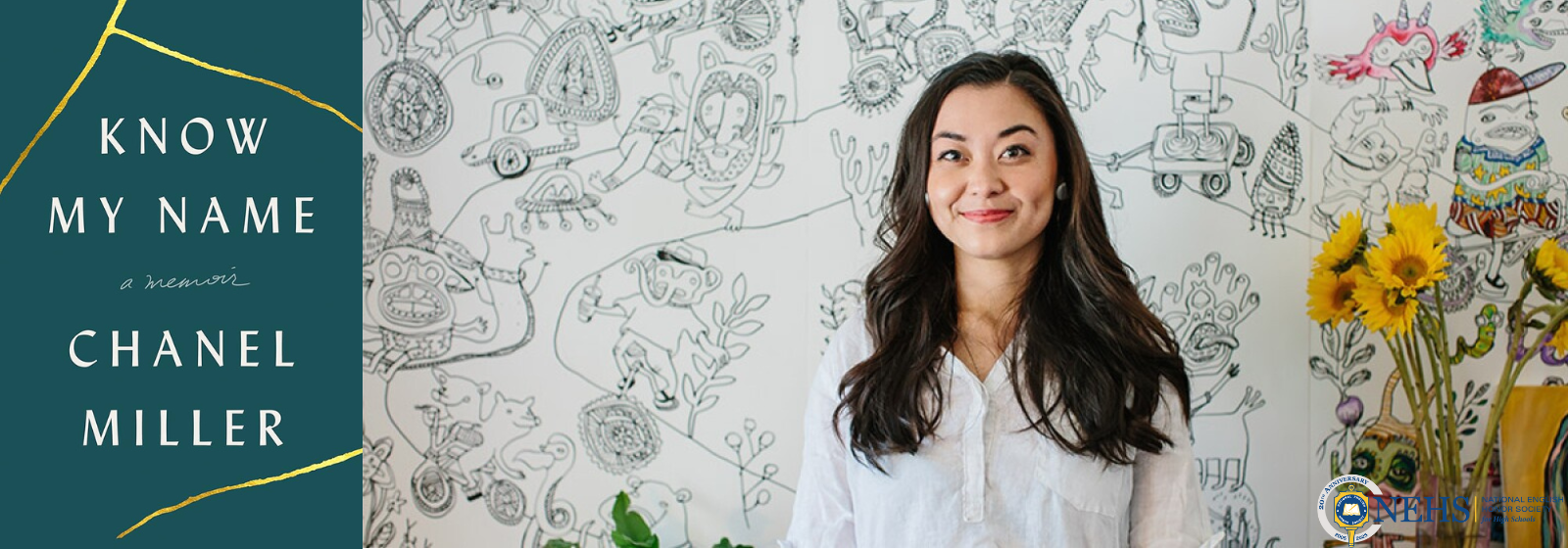
Can a person be born twice? Chanel Miller explores this idea in her memoir Know My Name. In this blog, AnnaClare Walker from TMI Episcopal School, Texas reflects on how Miller’s powerful storytelling resists erasure, reclaims her voice, and reminds readers that she is far more than a single moment—she is a full, complex human being. Read on to discover more about Chanel Miller.
Born Twice: Once in June, Once in September
Chanel Miller, author of Know My Name, was born on June 2, 1992, but in many ways, she was born again on September 4, 2019.
Due to laws protecting victims in cases of sexual assault, Chanel Miller’s identity was hidden and she became Emily Doe. The day her name and photo were released marked the end of “Emily Doe’s” life and the beginning of Miller’s reclamation as a full person to the world. She writes, “On September 4, 2019, my name and photo were released. My friend Mel texted me Happy birthday, because that’s what it felt like, being born into the world” (Miller 333). This figurative birth occurred four years after surviving an assault and the beginning of a long, painful, legal process that tried to rip away her name, voice, and identity.
While Miller’s actual birthday in June marks the start of her life, her memoir Know My Name, published on September 24, 2019, chronicles her fight to reclaim her identity. Through deeply personal short stories woven through the memoir, Miller refuses to be defined solely by the sexual assault she survived and, instead, builds a fuller, richer portrait of who she is and always has been.
Childhood and early adulthood memories reclaim her identity, presenting her as a sister, daughter, friend, artist, and writer. This longing to be seen is central to the memoir. During the trial, Miller existed as “Emily Doe,” a name stripped of personal history, “never called girl, only victim” (Miller 45). Sharing stories from her past pushes back against this identity, reminding the reader and author that Miller existed before and after the assault.
Chanel Miller’s personal stories in Know My Name humanize her after she endured a system that fought to dehumanize her. She describes past moments of joy, embarrassment, sorrow, and learning. The memoir takes readers into, and beyond, the courtroom, allowing them to see Miller’s whole experience. These stories delve into her relationships, perhaps none more so than the one between Miller and her sister, Tiffany. Describing herself as “more of a mother . . . than a sister” (Miller 187) to Tiffany, Miller delves deeper into their journey together. After breaking out of a changing room to help Tiffany, who was trapped inside, Miller realizes she “will always find a way” (184) to help and protect Tiffany. Their relationship helps Miller find the anger and strength to continue the trial, despite its many tolls. These universal experiences and emotions create a connection between Miller and the reader. These details force the reader to see Miller as a multifaceted individual instead of a statistic. They also highlight how much was stolen from Miller, physically, emotionally, and psychologically.
By including short, personal stories in her memoir, Miller demonstrates that reclaiming one’s voice requires telling the whole story, not just the parts beyond our control. Refusing to be flattened into a single event, she paints herself in full color, sharing her love for her family, awkward childhood moments, fears, and joys. Miller’s memories bring warmth and life to the memoir and act as a protest against a system that tried to erase her. These stories are reminders that Miller is both a survivor and a person, full of depth, spirit, and humanity.
This June, we wish a happy birthday to National Book Critics Circle Award winning writer Ms. Chanel Miller.

AnnaClare Walker is a 2025 senior at TMI Episcopal, Texas and member of the Artemisia Bowden Chapter of National English Honor Society.
National English Honor Society
The National English Honor Society (NEHS), founded and sponsored by Sigma Tau Delta, is the only international organization exclusively for secondary students and faculty who, in the field of English, merit special note for past and current accomplishments. Individual secondary schools are invited to petition for a local chapter, through which individuals may be inducted into Society membership. Immediate benefits of affiliation include academic recognition, scholarship and award eligibility, and opportunities for networking with others who share enthusiasm for, and accomplishment in, the language arts.
America’s first honor society was founded in 1776, but high school students didn’t have access to such organizations for another 150 years. Since then, high school honor societies have been developed in leadership, drama, journalism, French, Spanish, mathematics, the sciences, and in various other fields, but not in English. In 2005, National English Honor Society launched and has been growing steadily since, becoming one of the largest academic societies for secondary schools.
As Joyce Carol Oates writes, “This is the time for which we have been waiting.” Or perhaps it was Shakespeare: “Now is the winter of our discontent made glorious summer . . .” we celebrate English studies through NEHS.
National English Honor Society accepts submissions to our blog, NEHS Museletter, from all membership categories (students, Advisors, and alumni). If you are interested in submitting a blog, please read the Suggested Guidelines on our website. Email any questions and all submissions to: submit@nehsmuseletter.us.
